
Tuesday Tool Series #6: Player Props
Tuesday tool series, article 6 of 19. The tool: Player Props at theoddsgap.com/props
You have decided Kyle Schwarber is going deep tonight. That decision is the hard part and you have already made it. What happens next is that you open whichever app is on your home screen, tap the home run market, see a number, and take it. The bet is placed in about eleven seconds.
Here is what those eleven seconds cost. On the board this afternoon, fifteen books had a price on Schwarber hitting at least one home run against Milwaukee. The best of them paid $355 on a $100 bet. The worst paid $274. Same player, same game, same outcome, same night, and $81 of difference that has nothing to do with whether Schwarber actually hits the ball.
Game lines are bad for this. Props are much worse. A moneyline is priced by every book in the market, all of them watching each other, and they converge. A prop on the fourth hitter in a Tuesday night lineup is priced by a trader with less information and far less competition, and the numbers scatter. That scatter is invisible if you only look at one app, which is what almost everybody does.
What the tool does
The Player Props page puts every book's price on the same line, side by side, for every player on the board.
It opens on a grid: one row per player, one column per line. This afternoon that was 301 props across today's games, with sports, markets and dates across the top. Tap a price and it goes to your slip. Tap a player and the row opens into every book that has that player priced, laddered so the best number is findable at a glance.
It also grades. Where enough books quote both sides of a line, the page works out what the market as a whole thinks the chance is, compares that to the best price anyone is offering, and puts a badge on the ones where the best price is better than the market's own read. Twenty one of today's 301 props carried that badge.
A real example
Here is Schwarber's row, opened, exactly as it looked at 2:00 PM ET.
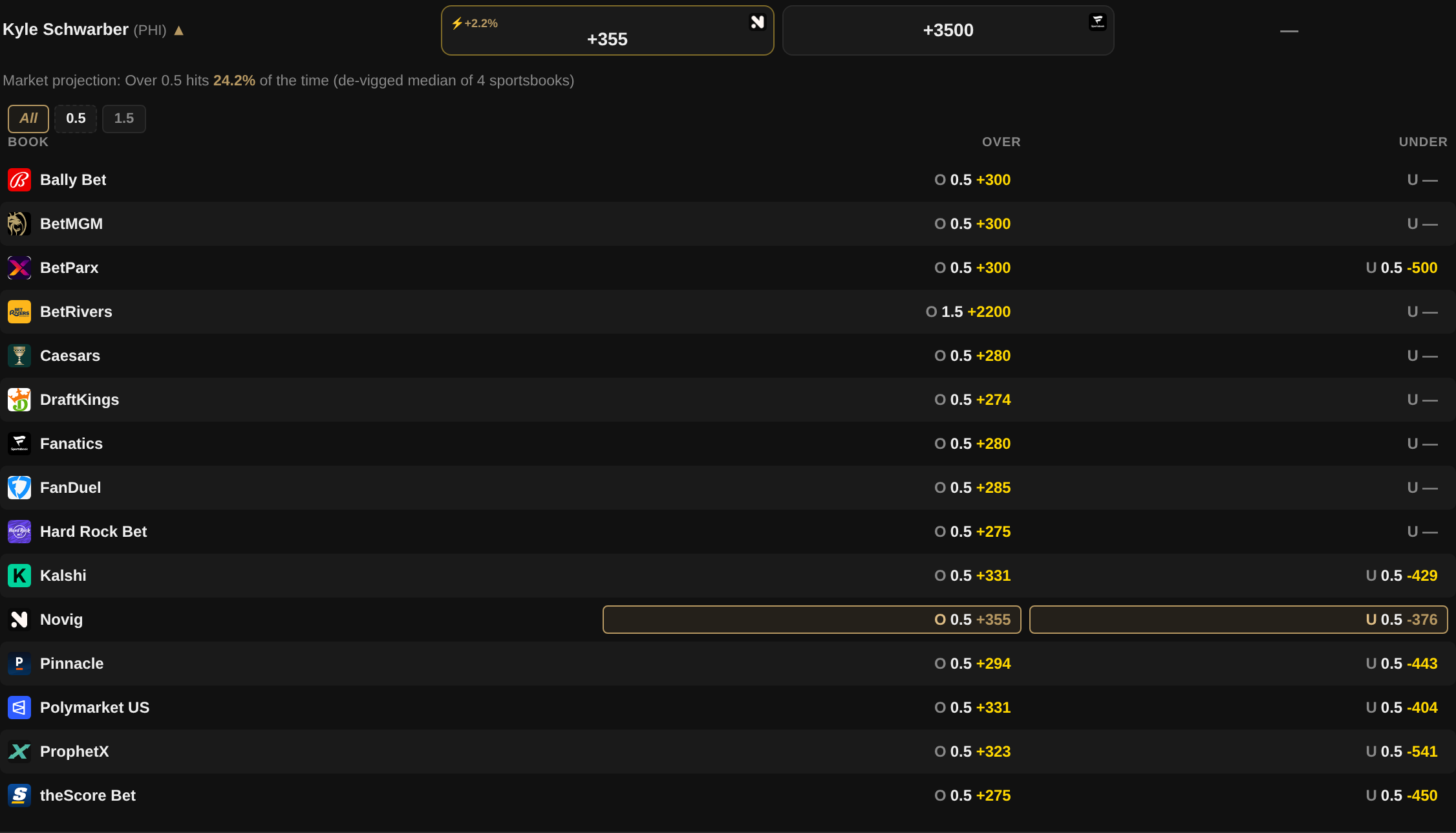
Fourteen of the fifteen books priced the 0.5 line. Best to worst:
| Book | Over 0.5 home runs |
|---|---|
| Novig | +355 |
| Kalshi | +331 |
| Polymarket US | +331 |
| ProphetX | +323 |
| Bally Bet | +300 |
| BetMGM | +300 |
| BetParx | +300 |
| Pinnacle | +294 |
| FanDuel | +285 |
| Caesars | +280 |
| Fanatics | +280 |
| Hard Rock Bet | +275 |
| theScore Bet | +275 |
| DraftKings | +274 |
BetRivers was the fifteenth and priced a different line, 1.5 home runs at +2200, which is a different bet and not comparable.
A hundred dollars on the top number wins $355. The same hundred on the bottom number wins $274. That is $81, or about 30 percent more on the identical wager, for the work of looking.
Now the part that is more interesting than the spread. The line at the top of the row reads: Over 0.5 hits 24.2% of the time, de-vigged median of 4 sportsbooks. That is the market's own estimate, built from the books quoting both sides with their margin stripped out.
At +355 you need the home run to land 22.0 percent of the time to break even. The market says 24.2. You are getting 2.2 points the right way, which is why the badge fires.
At +274 you need it to land 26.7 percent of the time. The market says 24.2. You are 2.5 points the wrong way.
Same bet, same night, same player. At one venue the market's own numbers say you have the better of it. At another they say you do not. Nothing about Schwarber changed between those two rows.
One note on Pinnacle at +294. It is on the page as a reference price because it is a sharp market worth seeing, but it is not licensed in any US state, so it is never counted as a best price here and most readers cannot bet it anyway.
How to use it
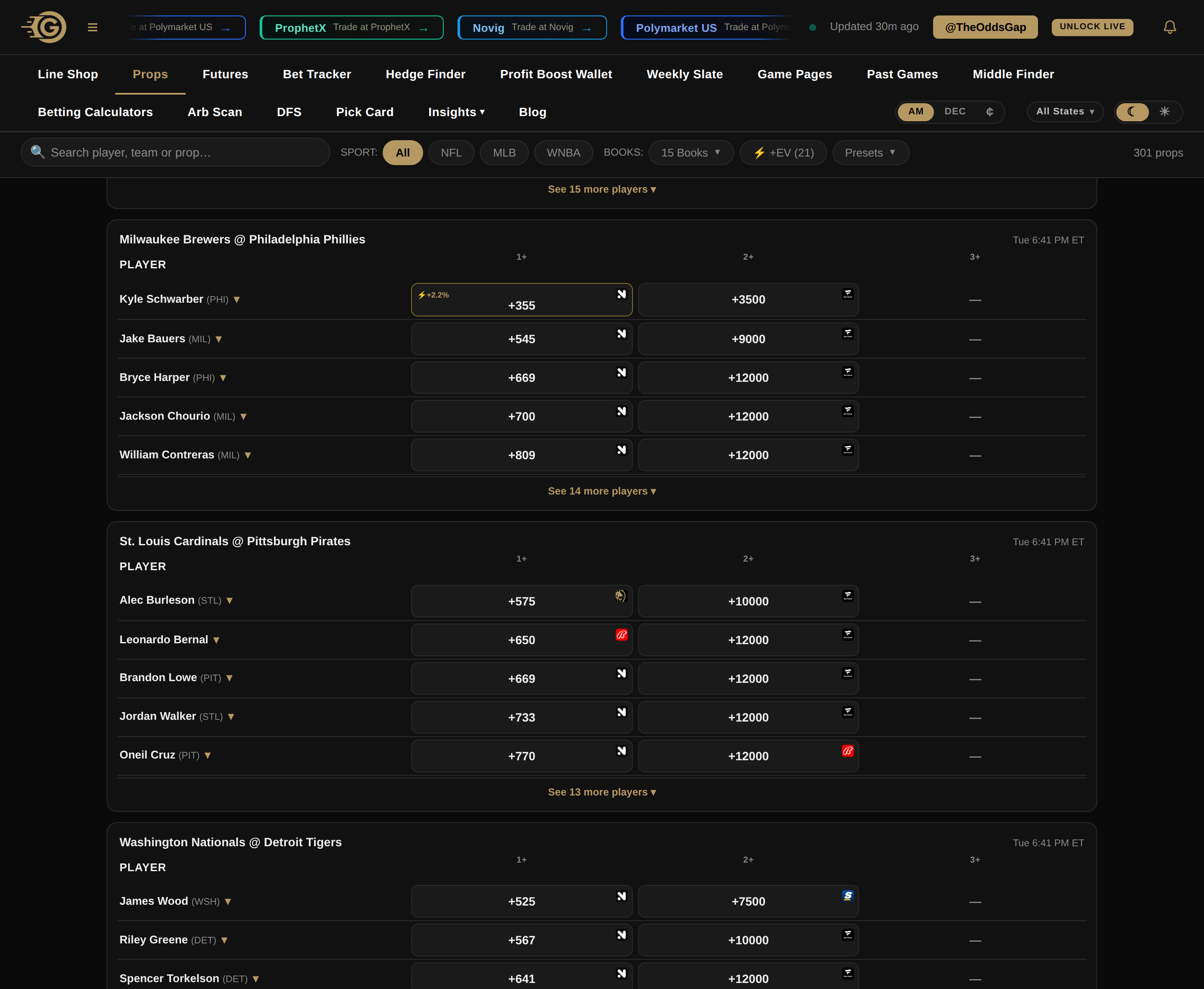
Start from the player, not the book. Search the name, or find the game card. The grid shows the best available price on each line, with the logo of whoever has it.
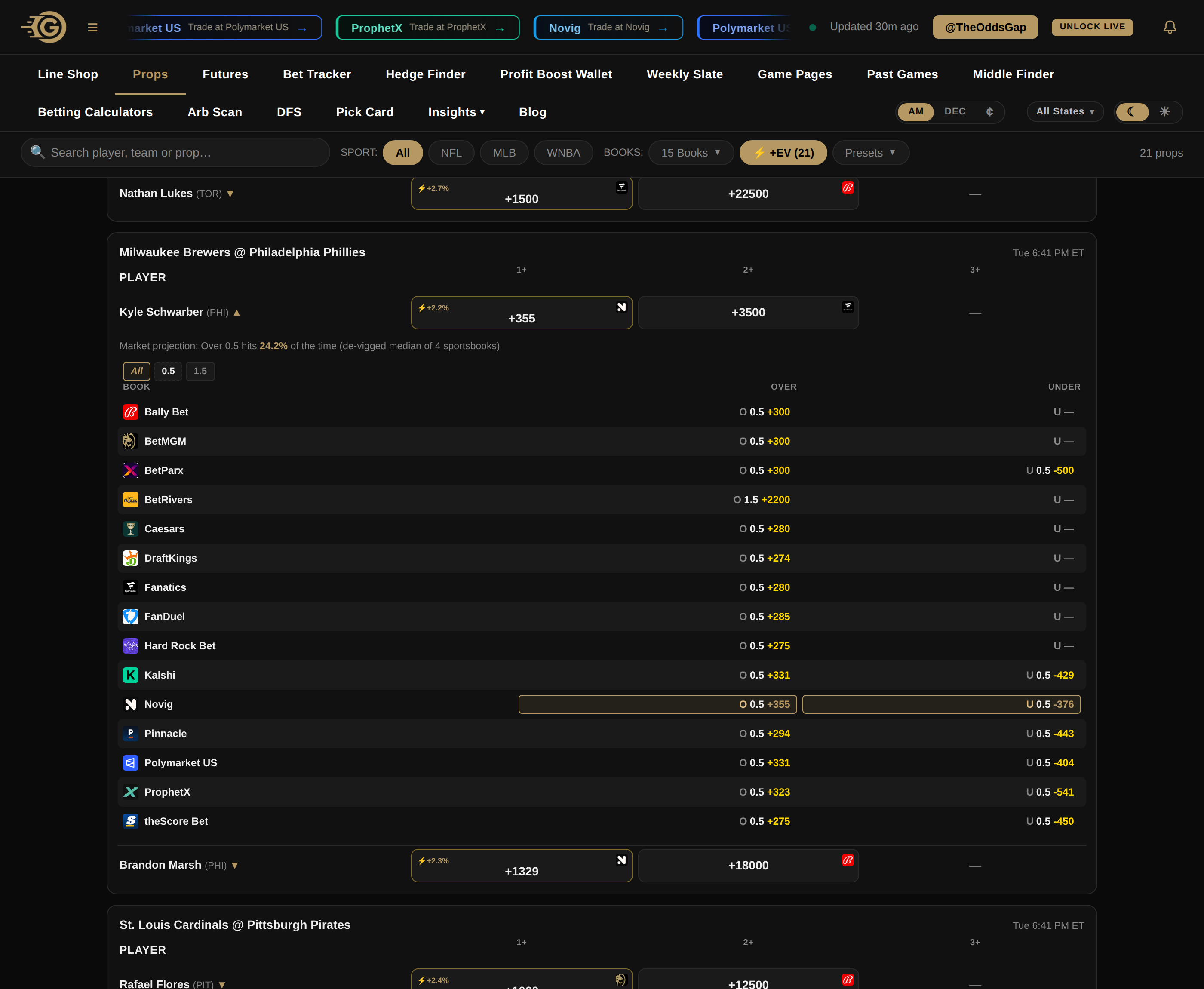
Open the row. One tap turns the row into the full ladder above. This is the only step that matters and most people never take it.
Use the line tabs. A prop is not one bet. Schwarber's row has tabs for All, 0.5 and 1.5, because books post different alt lines and burying them in one list makes the comparison useless. Pick the line you actually want, then compare.
Filter to the graded ones if you want a shortlist. The +EV chip cuts the board to the lines where the best price beats the market read. Today that was 21 of 301.
Set your books first. The book filter drops venues you cannot use, so the best price shown is the best price you can actually take rather than a number belonging to an app you have never signed up for.
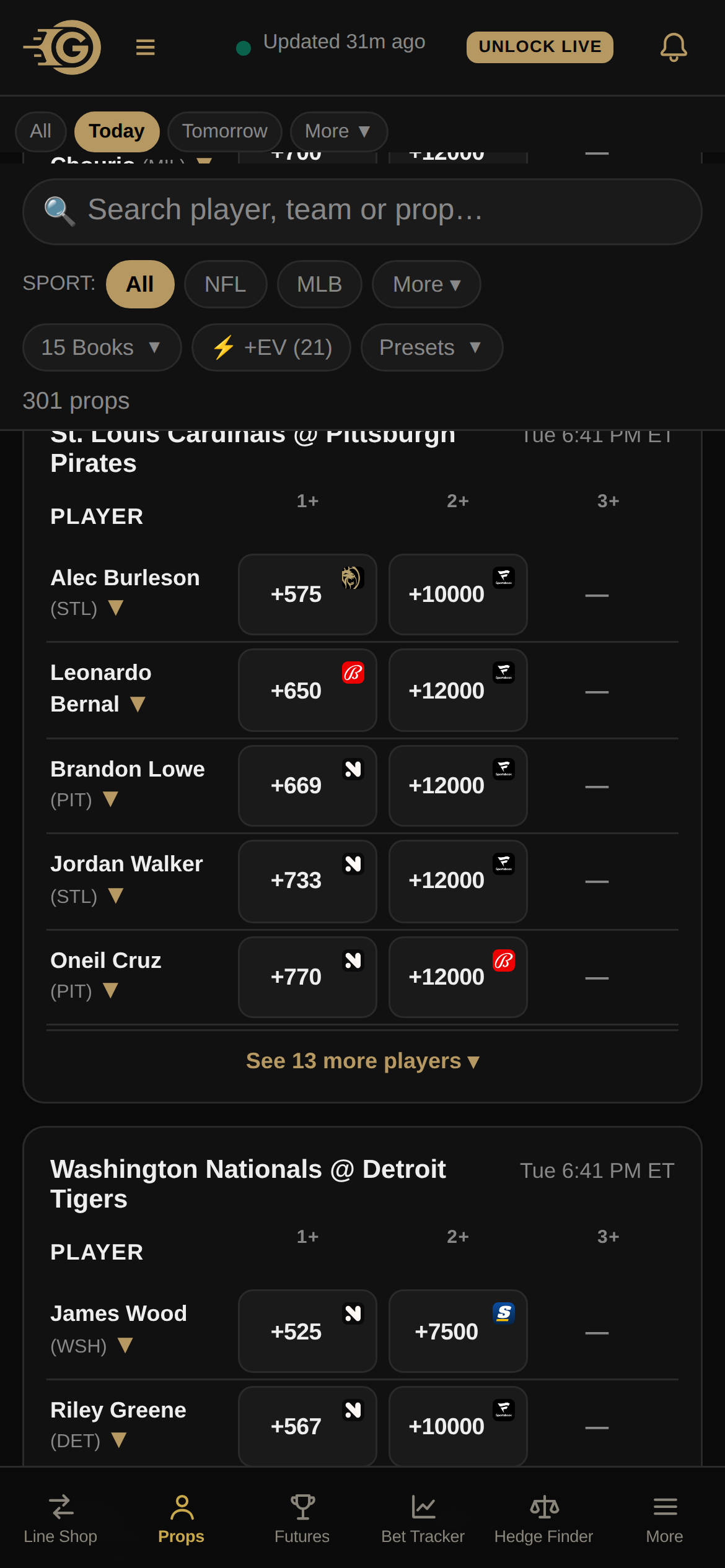
It works the same on a phone, which is where most of this gets checked.
The method
Props have no Pinnacle anchor the way game lines do, because Pinnacle does not post most player props. So the market grades itself.
For every line, the page takes each sportsbook quoting both sides, strips the margin out of each one to get an implied probability for the Over, and takes the median of those. That median is the fair value. At least three sportsbooks have to quote both sides, or no fair is published and the line gets no badge at all.
Then it finds the best available price across everyone, exchanges included, and the edge is the fair probability minus that price's implied probability, in percentage points. Two points or more earns the badge.
The exchanges get a deliberately asymmetric deal. Kalshi, Polymarket US, ProphetX and Novig are excluded from the fair calculation but included in the best price. The reasoning is that an exchange price is a real price you can take, so it always competes, but the exchanges are thin and they move together, and letting them vote on what fair means grades them against a number their own quote helped set. That cost something honest: lines quoted two-sided by only two sportsbooks lost their badge entirely.
Two guards sit on top. A price more than 15 percentage points away from the median is dropped as stale before the best price is picked, so one frozen quote cannot manufacture an edge, and edges above 15 points are hidden as probable bad data rather than shown. The full write-up is on the methodology page.
What it does not do
This is the section nobody else writes, so here it is.
It does not know whether Schwarber will hit a home run. There is no model here. No projection, no injury adjustment, no weather, no park factor, no lineup read. The page tells you where a bet you have already chosen pays the most. That is the whole product.
The fair value is a consensus, not the truth. It is a median of four sportsbooks on this line. Four books can be wrong together, and on a thin prop they often are. A badge means the best price beats what those books think. It does not mean the bet wins.
The free board is a snapshot, not a feed. Props refresh every four hours on the free board. That matters more than it sounds, and this article is its own evidence: at 1:00 PM the best price on this exact prop was +368 at ProphetX with 3.2 points of edge. By 1:30 it was +355 at Novig with 2.2 points. Half an hour, different best book, different number, smaller edge. Check the timestamp at the top of the page before you act on anything, and treat every number here as a starting point for where to look rather than a quote.
Exchange prices are real but the size behind them is not shown. Novig had the best number tonight. How much you can get on at that number is not something this page can tell you.
Props only appear when the game comes close. Nothing is priced more than about two days out. On a Tuesday in football season the NFL board is empty, not because the tool is broken, but because the books have not posted the week's props yet. They fill in as the games approach.
It cannot make a bad bet good. Getting the best number on a prop you should not be betting is still a bet you should not be making. Shopping raises the ceiling on your results. It does not choose the bet.
The point
Everything above is the same idea applied to a harder market. The prices disagree, the disagreement is worth real dollars, and almost nobody checks because checking used to mean fifteen tabs.
Math, not picks. Free, no signup.
Open the Player Props board
Every book's price on the same line, for every player on tonight's board.
Open Player Props →Every price above was read off the live player props board at 2:00 PM ET on September 22, 2026, from a board that had last refreshed at 1:30 PM ET. The earlier figures quoted in the snapshot section were read at 1:00 PM ET the same day. Prices move, and props move faster than game lines, so always verify a price on the page before placing any bet. Nothing here is a pick or a projection. Please gamble responsibly.