
Tuesday Tool Series #7: Betting Calculators
Tuesday tool series, article 7 of 19. The tool: Betting Calculators at theoddsgap.com/betting-calculators
You are putting together a Sunday parlay. Three favorites: the Bills at home against the Chargers, the Ravens in Dallas, the Rams in Denver. You open your app, add the three legs, and it tells you what $100 pays. The number looks fine. It is always going to look fine, because it is the only number on the screen.
Here is what that screen does not show you. On the Wednesday before Week 3, ten US sportsbooks priced all three of those legs. The same $100 on the same three teams paid $249.27 in profit at the best of them and $230.12 at the worst. That is $19.15 for typing the same three legs into a different app, and nothing about the games changed.
Nobody hides this from you on purpose. It is just that one app can only show you its own price, and the arithmetic that would reveal the difference is tedious enough that almost nobody does it. That is what calculators are for.
What the tool does
The Odds Gap has eleven betting calculators, free, on one page, with a switcher at the top so you can move between them without losing your place.
They fall into four groups:
- Reading a price. The Odds Converter turns American, decimal and fractional odds into each other and into an implied probability. The Hold Calculator tells you how much margin a book built into a market. The No-Vig Calculator takes that margin back out and shows you the fair price underneath.
- Building a bet. The Parlay Calculator and the Teaser Calculator price multi-leg tickets.
- Checking a bet. The EV Calculator compares a price to a probability you supply. The Kelly Calculator turns that same comparison into a stake size.
- Locking in math. The Hedging Calculator, the Futures Hedge Calculator, the Arbitrage Calculator and the Middle Calculator size the second bet when you already hold the first, or when two books disagree enough to cover both sides.
Each one explains its math on its own page, so you can check it by hand.
A real example
Here is that parlay, leg by leg, as each book priced it at 8:40 PM ET on Wednesday. Sportsbooks only, because a parlay has to be placed at one book and the exchanges and prediction markets each price combinations on their own terms.
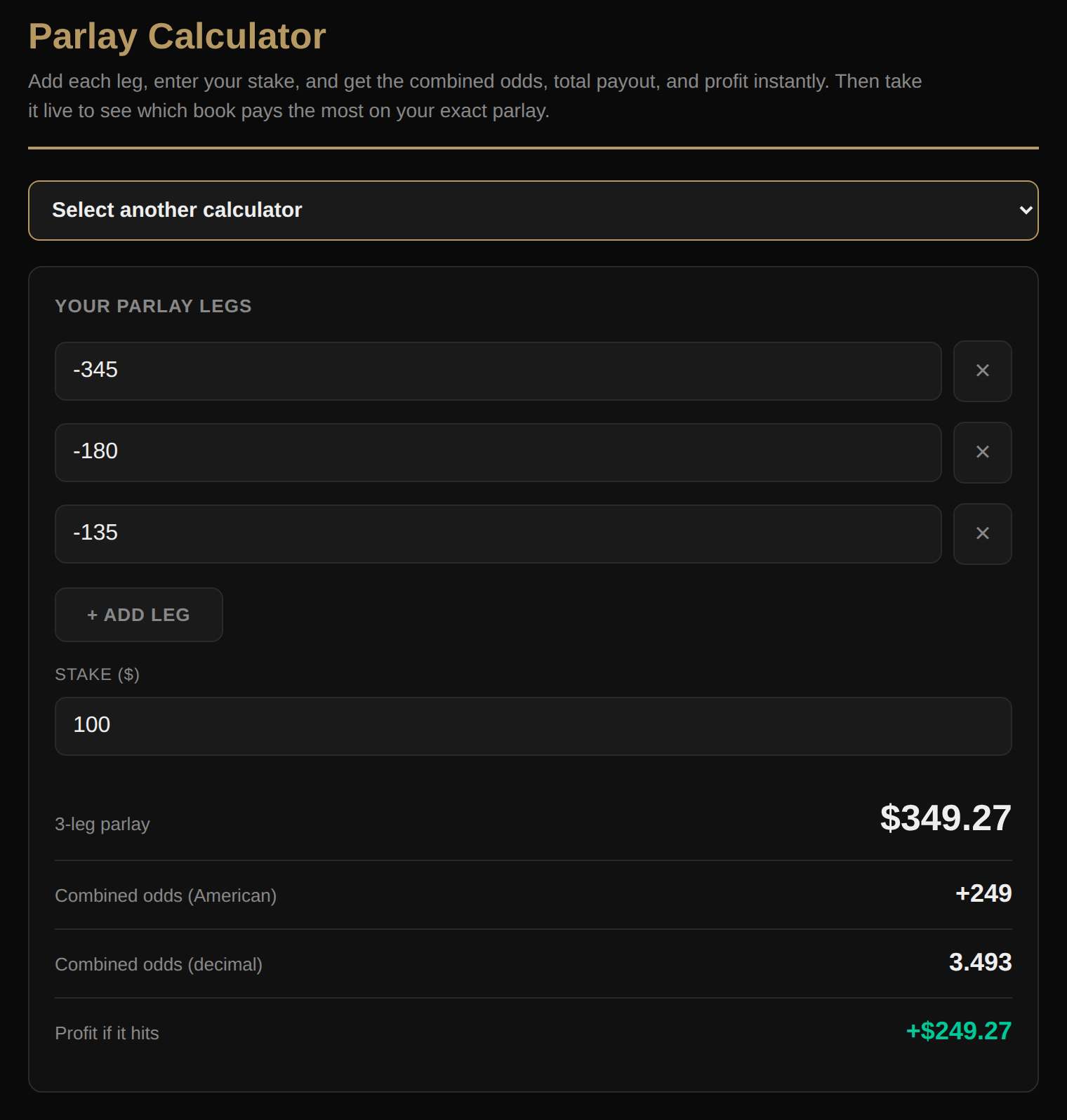
Profit on $100, best to worst:
| Sportsbook | Bills, Ravens, Rams | Profit on $100 |
|---|---|---|
| DraftKings | -345, -180, -135 | $249.27 |
| Caesars | -335, -176, -143 | $246.03 |
| Hard Rock Bet | -350, -185, -140 | $239.55 |
| BetParx, BetRivers and Bally Bet | -385, -175, -141 | $238.36 |
| FanDuel | -375, -178, -142 | $237.14 |
| BetMGM and Fanatics | -350, -190, -145 | $231.58 |
| theScore Bet | -400, -185, -140 | $230.12 |
Two things in that list are worth slowing down for.
The best price on one leg does not make the best parlay. No book had the best price on more than one leg. Caesars had the best Bills price, -335, and was one point off the best Ravens price. BetParx, BetRivers and Bally Bet had the best Ravens price, -175, and finished fourth. DraftKings had the best on only the Rams, -135, and trailed on the other two, but that Rams price was far enough ahead to pay the most. You cannot see that by eyeballing three prices. You can see it in about ten seconds with the calculator.
Small differences compound. No single leg in that list differs by much. Worst to best, it is -400 against -335 on the Bills, -190 against -175 on the Ravens and -145 against -135 on the Rams. Each one alone is a few dollars. Multiplied through three legs at one book, they are how DraftKings and theScore Bet end up $19.15 apart.
So why does one book pay less on the same three games? The Hold Calculator answers that. Take the Chargers at Bills moneyline, the first leg, at two of the books above.
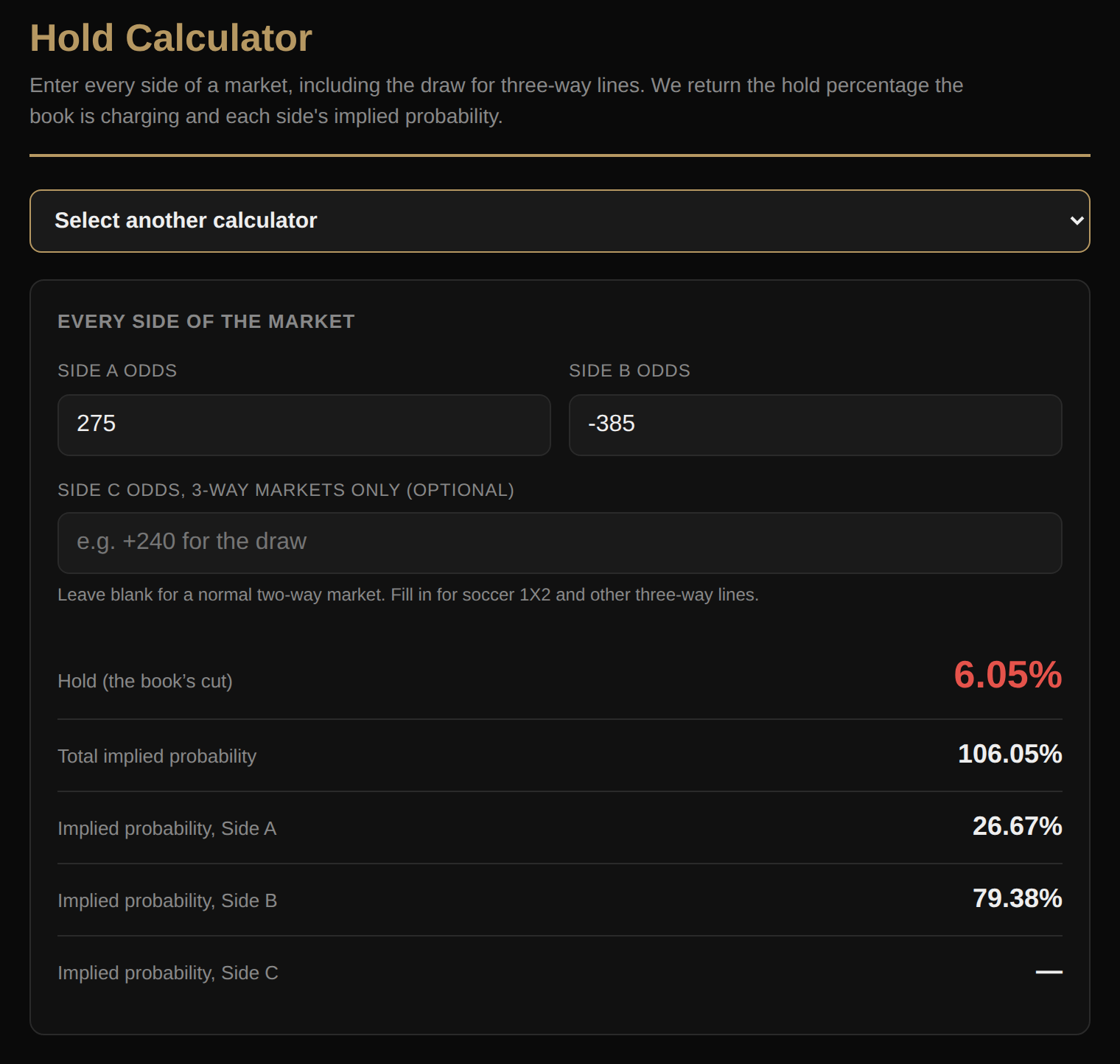
BetRivers had the Chargers at +275 and the Bills at -385. Add up the probability those two prices imply and you get 106.05%. The extra 6.05% is the book's cut, called the hold. BetMGM on the same game was +290 and -350, a hold of 3.42%. BetParx and Bally Bet matched BetRivers at 6.05%. Same game, same moment, and the margin built into the price at one book was nearly double the margin at another.
That is not a knock on anyone. Books take different positions on different games, and which book runs the lowest margin changes from game to game and week to week. It is the reason the best price moves around, and the reason checking is worth doing every time rather than once.
The No-Vig Calculator takes that margin back out. FanDuel had the Rams at -142 and the Broncos at +120, a 4.13% hold. Strip it out and the fair prices are Rams -129 and Broncos +129.
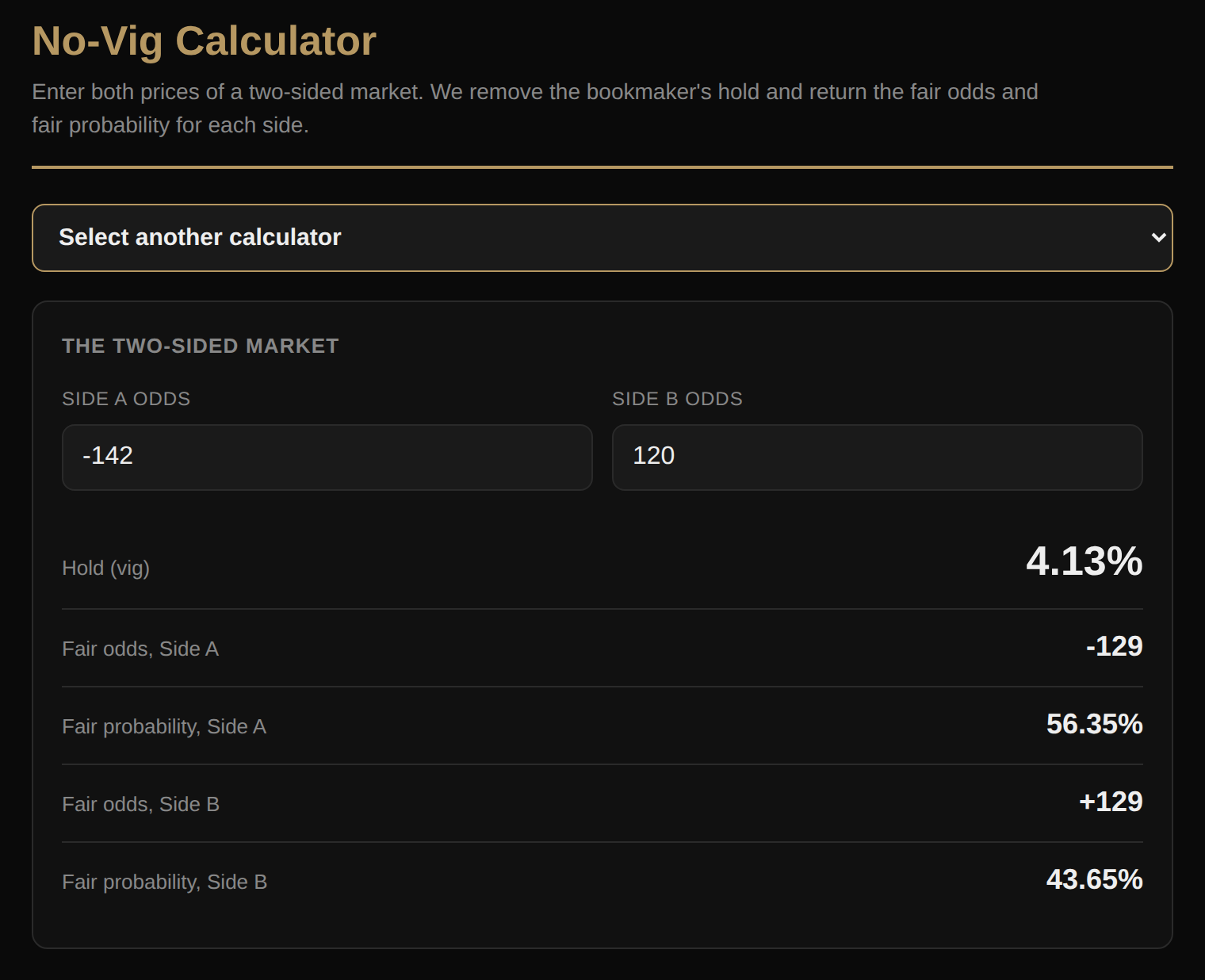
Now look at the board. The best sportsbook price on the Broncos was +121, at Caesars. The best anywhere was +127, on Novig. Nobody was paying +129. That is normal. Fair is where a price would sit with no margin at all, and every venue takes some. What the calculator tells you is how far each price is from fair, which is the same thing as how much each book is charging you for that bet.
How to use them
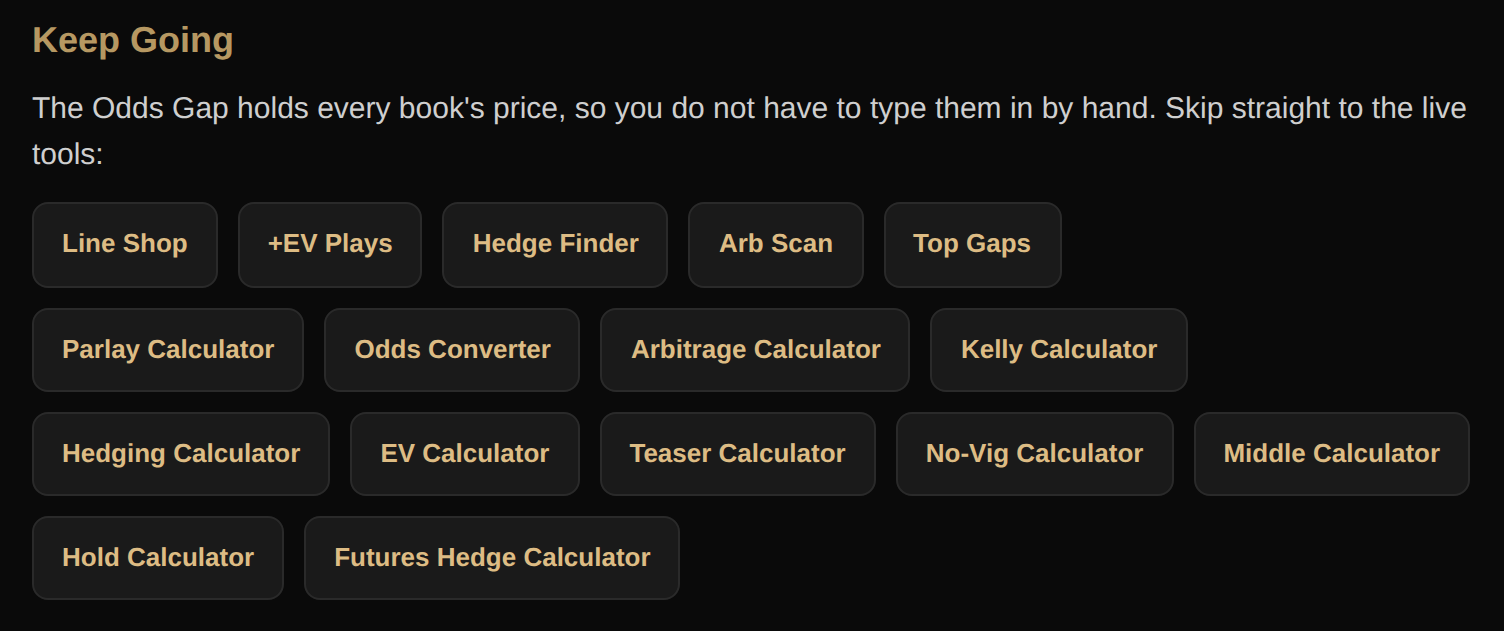
Start with the one that matches your question. Want to know what a price means? Odds Converter. Want to know what a book is charging? Hold. Want to know what a price would be with no charge? No-Vig. Have a ticket and want the other side sized? Hedging.
Type the prices exactly as the book shows them. American odds, with the minus sign. If your book shows decimal or fractional odds, the Odds Converter turns them into American first.
Move between them with the switcher. "Select another calculator" sits above every one, so the hold on a line and its fair price are one click apart.
Then stop typing. This is the part that matters most, and it is why the calculators sit on the same site as the live board. Calculators are homework. A finder does the work.
Every price in this article was one we already had. The Line Shop shows every book's price on every side, so the hold comparison above is visible at a glance. The Pick Card builds a parlay and prices it across every sportsbook at once, which is the whole worked example above with no typing. The Hedge Finder takes a ticket you hold and finds the best price on the other side. The calculators are for when you want to see the arithmetic, or check a price we do not carry.
The math
Every calculator explains its math on its own page. The core of it fits in a few lines.
American to decimal: a plus price +A becomes 1 + A/100, and a minus price -A becomes 1 + 100/A. Implied probability is 1 divided by the decimal price.
A parlay pays the stake times every leg's decimal price multiplied together. That multiplication is why small differences compound: DraftKings' three legs multiply to 3.493, theScore Bet's to 3.301.
Hold is the sum of every side's implied probability, minus 100%. On a two-way market that is the whole of the margin.
The No-Vig Calculator removes that margin in proportion to each side's implied probability, which is the standard textbook method and the easiest one to check by hand. The site's own fair prices use a slightly different method, the power method, which moves a little more of the margin onto the longshot, because books tend to load their margin there. On most lines the two agree within a fraction of a point. On the Rams line above, the proportional method gives -129 and +129 and the power method gives -131 and +131. The methodology page says which fair each part of the site uses.
What they do not do
This is the section nobody else writes, so here it is.
They only know what you type. A calculator cannot tell you that a price has moved, that a book has pulled a line, or that you mistyped -135 as -153. It will do exactly the arithmetic you gave it, instantly and correctly, on whatever numbers you gave it.
They cannot tell you whether a price is still there. Every number in this article is a snapshot from Wednesday night. By the time you read this, every one of them has moved and the games have been played. Check the time on any price before you act on it.
A parlay calculator assumes the legs are independent. For three different games, that is right. For a same-game parlay, where the legs are related, books price the combination their own way and a simple multiplication will not match what they offer.
No-vig from one book is one book's opinion. Removing FanDuel's margin gives you FanDuel's fair price, not the market's. The live board never leans on one retail book: game-line fair prices come from the sharpest two-sided market, and prop fair prices from a median of at least three sportsbooks quoting both sides.
The EV and Kelly calculators are only as good as the probability behind them. The EV Calculator can build one from a sharp two-sided price you type in; the Kelly Calculator needs one supplied. If that chance is wrong, the answer is wrong with exactly the same confidence. We do not predict games, so the only probability we can offer is the market's own, de-vigged, which is a consensus and not the truth.
Locking math is not a promise about a game. The hedging, arbitrage and middle calculators size bets so the arithmetic comes out the same either way, at the prices you entered. If a price moves or a book limits your stake before the second bet is placed, the arithmetic changes with it.
None of them picks a side. Nothing on this page tells you what to bet. They tell you what a bet costs and what it pays.
The point
Every bettor does this math eventually, usually after the fact, usually on the one book they happened to have open. The calculators make it ten seconds instead of ten minutes. The board makes it zero.
Math, not picks. Free, no signup.
Open the calculators
Eleven of them, one click apart, with the math on every page.
Open Betting Calculators →Every price above was read off the live game pages at 8:40 PM ET on Wednesday, September 23, 2026, before Week 3 kicked off, and run through the calculators at 8:44 PM ET. The parlay figures multiply each sportsbook's own straight prices; a book's actual parlay offer can differ by rounding or promotions. Prices move, so always verify a price before placing any bet. Nothing here is a pick. Please gamble responsibly.