
Tuesday Tool Series #4: +EV Plays
Tuesday tool series, article 4 of 20. The tool: +EV Plays at theoddsgap.com/ev
+EV Betting, Explained With a Real Line: What "Positive Expected Value" Actually Means
1. The Problem
You back a team at +200. It loses. Was that a bad bet?
Most bettors have no way to answer that, so they answer it with the result. Win, good bet. Lose, bad bet. That is the single most expensive habit in betting, because a single game tells you almost nothing about whether the price you took was any good. A coin flip priced at +200 is a wonderful bet and it still loses half the time.
The thing you can actually judge, immediately, before the ball is thrown, is the price. Every sportsbook price contains a probability, and every sportsbook price contains a margin on top of that probability. If you can strip the margin out and see the number underneath, you can compare it to what you are being paid. That comparison is expected value, and it is the only part of a bet you control.
2. What the +EV Plays Board Does
The +EV board takes one reference price, removes the book's margin from it to get a fair probability, and then checks every other book we track to see if anybody is paying more than that probability is worth.
Where the reference comes from matters. We use Pinnacle. Pinnacle takes the largest limits in the sport, moves its line on professional money rather than public money, and runs a thinner margin than the retail books do. It is the price the academic literature on betting markets uses as the closest available stand-in for a true probability. It is not truth. It is the best public proxy for truth, and we say so on every page that uses it.
So the board is answering a narrow question, precisely: on this exact market, is anyone paying more than the sharpest available price says this outcome is worth? Anything above zero shows on the board. The single play that goes into the daily email and the public record has to clear a 1.5% bar.
3. A Real One, Worked Start to Finish
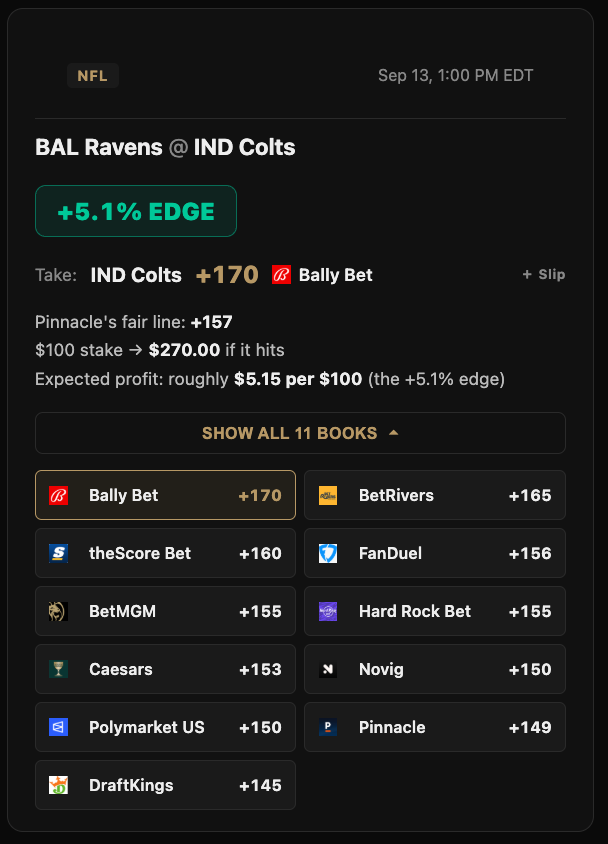
Here is a line taken off the free board yesterday afternoon, 3:06pm ET on Monday, August 17, 2026. NFL Week 2, Baltimore Ravens at Indianapolis Colts, September 13. Moneyline on the Colts, the home underdog.
Pinnacle's two-sided price at that moment:
- Baltimore (away): -170
- Indianapolis (home): +149
Step 1. Convert both sides to implied probability.
- Baltimore at -170: 170 / (170 + 100) = 62.96%
- Indianapolis at +149: 100 / (149 + 100) = 40.16%
Step 2. Add them up.
62.96 + 40.16 = 103.12%
A real probability distribution sums to 100. This one sums to 103.12, and those extra 3.12 points are the hold: Pinnacle's margin, baked into both prices. Every book does this. Pinnacle just does it with a lighter hand, which is exactly why we use it as the reference. A standard -110 / -110 retail market sums to about 104.8, and plenty of props run past 110.
Step 3. De-vig, using the power method.
The naive approach is to scale both sides down proportionally: 40.16 / 103.12 = 38.94% for Indianapolis. We do not do that, because the margin is not spread evenly across a market. Books load more of it onto the longshot side, the well documented favorite-longshot bias, so proportional scaling leaves the underdog looking better than it is.
Instead we solve for the exponent k that renormalizes the pair:
0.6296^k + 0.4016^k = 1
k = 1.0483
Apply it:
- Baltimore: 0.6296^1.0483 = 0.6157 → 61.57%
- Indianapolis: 0.4016^1.0483 = 0.3843 → 38.43%
Sums to 100.00%. That is the fair line. Note the difference from the naive method: 38.43% instead of 38.94%, half a percentage point stricter on the underdog. Half a point sounds like nothing until you see the ladder below, where the entire edge on the best available price is 1.4 points. The de-vig method is not a detail.
Step 4. Turn the fair probability into a price.
38.43% converts to +160. That is what Colts moneyline is worth, according to the sharpest price on the board.
Step 5. Ladder every book against it.
Best to worst, all seventeen venues quoting the game at 3:06pm ET on Monday, August 17th:
| Venue | Colts ML | Break-Even Needed | EV |
|---|---|---|---|
| BetPARX | +170 | 37.04% | +3.8% |
| Bally Bet | +170 | 37.04% | +3.8% |
| BetRivers | +165 | 37.74% | +1.8% |
| theScore Bet | +160 | 38.46% | -0.1% |
| BetOnline | +157 | 38.91% | -1.2% |
| LowVig | +157 | 38.91% | -1.2% |
| FanDuel | +156 | 39.06% | -1.6% |
| BetMGM | +155 | 39.22% | -2.0% |
| Hard Rock Bet | +155 | 39.22% | -2.0% |
| Caesars | +153 | 39.53% | -2.8% |
| Kalshi | +152 | 39.68% | -3.2% |
| Novig | +150 | 40.00% | -3.9% |
| Polymarket US | +150 | 40.00% | -3.9% |
| Bovada | +150 | 40.00% | -3.9% |
| Pinnacle | +149 | 40.16% | -4.3% |
| MyBookie | +147 | 40.49% | -5.1% |
| DraftKings | +145 | 40.82% | -5.9% |
The EV column is the whole article. Take BetPARX at +170: decimal 2.70, multiplied by the fair probability 0.3843, minus 1, equals +3.8%. In plain terms, +170 only needs the Colts to win 37.04% of the time to break even, and the sharp line says they win 38.43% of the time. That 1.4 points of cushion is the entire edge, and it is worth a shade under four cents on the dollar over a long run of bets like it.
Two honest notes on that ladder. First, the spread from top to bottom is 25 cents on the same bet, +170 down to +145, and the difference between the best price and a merely popular one is the whole game. Second, most of that ladder is priced fine. Fourteen of seventeen venues are at or below fair, which is exactly what you would expect, and it is why a +EV board is usually short.
4. How to Use It
- Open theoddsgap.com/ev.
- Set your state in the top nav. Books that cannot legally take your action are removed from every calculation, so a play you cannot place never shows up.
- Filter by sport if you want. The board covers whatever is in season.
- Read the edge column, not the price column. A +400 play with a 0.4% edge is worse than a -180 play with a 2% edge, every time.
- Click through to the book. The deep link opens that exact bet on the slip.
- Re-check the price on the book before you confirm. The free board is an hourly snapshot and lines move. If the price has moved against you, the edge is gone and the bet is not the same bet.
That last step is not boilerplate. A 1 to 3% edge is thin enough that a two-cent move erases it.
5. The Method, in One Paragraph
For every market where Pinnacle has posted a two-sided price, we de-vig that pair with the power method above to get a fair probability for each side. Then, for every other tracked book quoting the same market, EV% equals decimal odds multiplied by the fair probability, minus one. Above zero, it lands on the board. When Pinnacle is offline or has not posted the game, the row is hidden rather than guessed at. Exchange prices go in after fees and at a realistic fill. The full write-up, including how spread and total lines are chosen and how each venue's fee is handled, is at theoddsgap.com/methodology.
6. What This Does Not Do
This is the part most sites leave out, so here it is straight.
It does not predict games. There is no model. Nobody here knows whether the Colts win. The board compares prices, and that is all it does.
It assumes Pinnacle is right. The entire calculation rests on the de-vigged Pinnacle line being a good estimate of the true probability. It is the best public proxy available and it is still an estimate. When Pinnacle is wrong, every number on the board inherits that error.
A 3.8% edge is small and slow. It means that if you placed a thousand bets exactly like this one, you would expect to finish about 3.8% of your total stake ahead. It does not mean this bet is likely to win. It is an underdog at +170 and it will lose about three times in five.
Prices move, and yesterday's edge is not today's edge. The Colts number above was true at 3:06pm ET on Monday. That game is four weeks out, so by the time you read this the ladder will have shuffled. The point of the worked example is the method, not the play. Run it yourself on whatever is on the board when you get there.
Our own public record is currently underwater. We publish every single daily +EV pick from our daily newsletter (does not have a +EV play every day), win or lose, at theoddsgap.com/the-odds-gap-daily-record.
We retracted our own work once already this month. A separate confidence-signal experiment, which scored plays and looked strongly profitable on paper, turned out to be measuring a pricing bug on one exchange rather than a real edge. Repriced against actual order books, the positive result went negative. We killed it, published the retraction, and nobody had staked a dollar. That is what we would want to read before trusting anyone's numbers, so it is what we publish.
And it does not tell you what to bet. Math, not picks. The board shows you where the price beats the sharp line. What you do with your money is yours.
See Today's Board
Every play where the best available price beats the de-vigged sharp line, sorted by edge.
Open +EV Plays →Every price above is a real quote off the board, captured at 3:06pm ET on Monday, August 17, 2026. The play card was captured later the same day, which is why its edge and fair line differ from the worked example. Odds move constantly, so always verify a price at the book before placing any bet. This is a price comparison, not betting advice. Please gamble responsibly.