
Who Actually Has the Best Odds: FanDuel, DraftKings, Polymarket, or Kalshi?
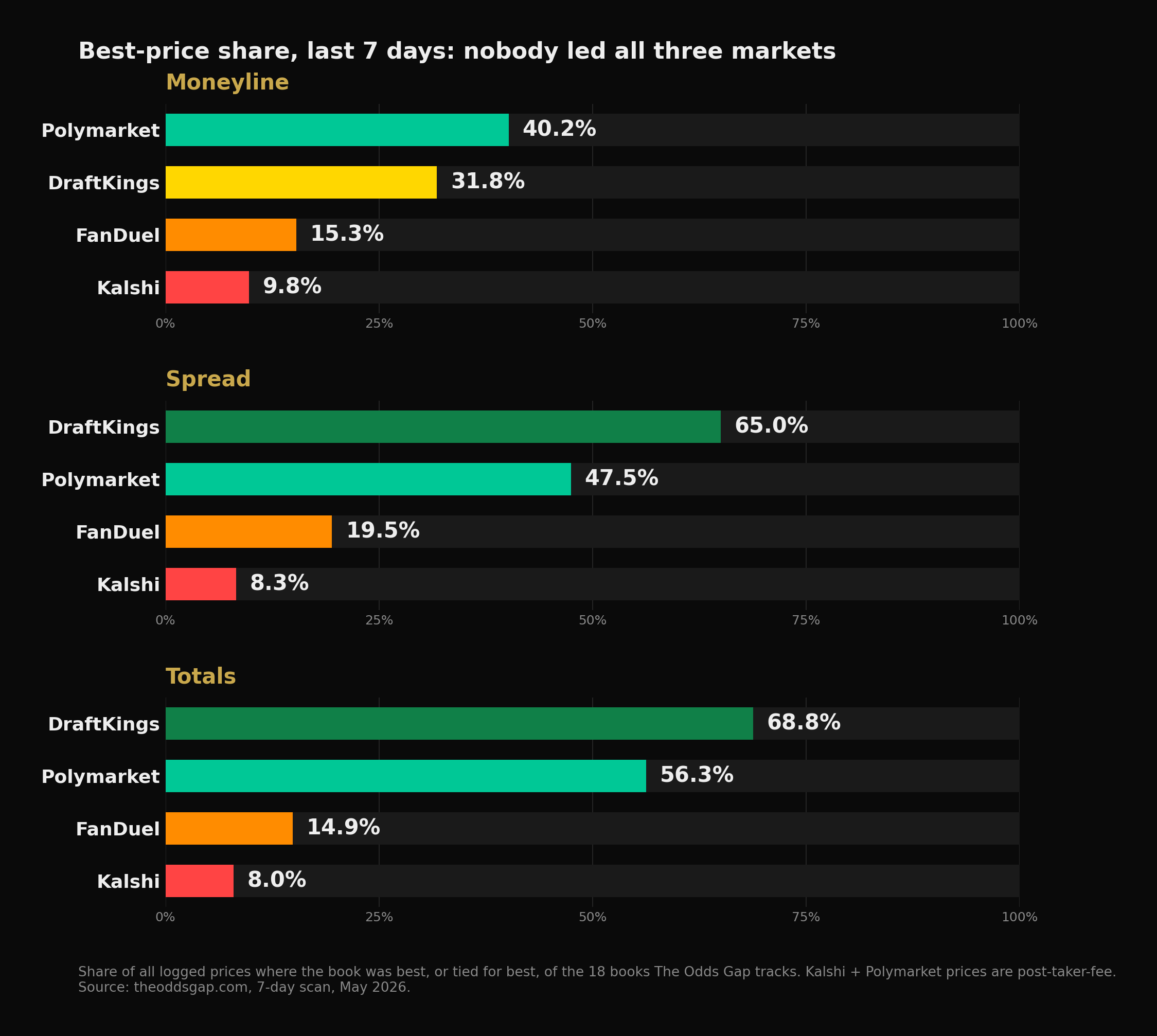
For the last seven days, The Odds Gap logged the price at eighteen books every hour and recorded which one had the best number on every moneyline, spread, and total. Four of the biggest names in the market split the week, and no two of them won the same way. Polymarket had the best moneyline price 40.2% of the time, the most of any book tracked. DraftKings owned spreads at 65.0% and totals at 68.8%. FanDuel finished mid-pack on all three. Kalshi, after its per-contract taker fee, finished last of the four on every market. No single book led everywhere, which is the entire reason line shopping pays.
A note on how this is measured. The Odds Gap pulls every major book at the top of every hour, 7am to 9pm ET, and records which book offered the best available price on each market. The percentages here are best-price share: out of every price logged for a book over the last seven completed days, how often that price was the best of the eighteen books tracked, ties included. When several books land on the same best number, every one of them gets the credit, so a book is never punished for matching the market's best line instead of uniquely beating it. Both sides of every market count, so a single moneyline contributes a favorite price and an underdog price. Kalshi and Polymarket prices are post-fee. Both exchanges charge a per-trade taker fee, and The Odds Gap bakes that fee into the displayed odds because a bettor taking the price actually pays it. More on those fees further down.
The moneyline belongs to Polymarket
Polymarket had the best moneyline price 40.2% of the time it was quoting a game, the highest share of any of the eighteen books in the field. DraftKings came in at 31.8%. FanDuel was at 15.3%, and Kalshi at 9.8%.
The shape of the moneyline is what makes it friendly to an exchange. Moneyline prices spread across a wide range, from near-even games to heavy favorites at -300 and worse. The wider that range, the more room there is between a sportsbook's price and the true probability, and an exchange price floats to wherever buyers and sellers actually meet. Polymarket, with no vig built into the line and a small taker fee, lands inside that gap often enough to lead the entire market.
It helps to look at the other end of the same market. Best-price share tells you who led. Worst-price share tells you who stuck you with the bad number.
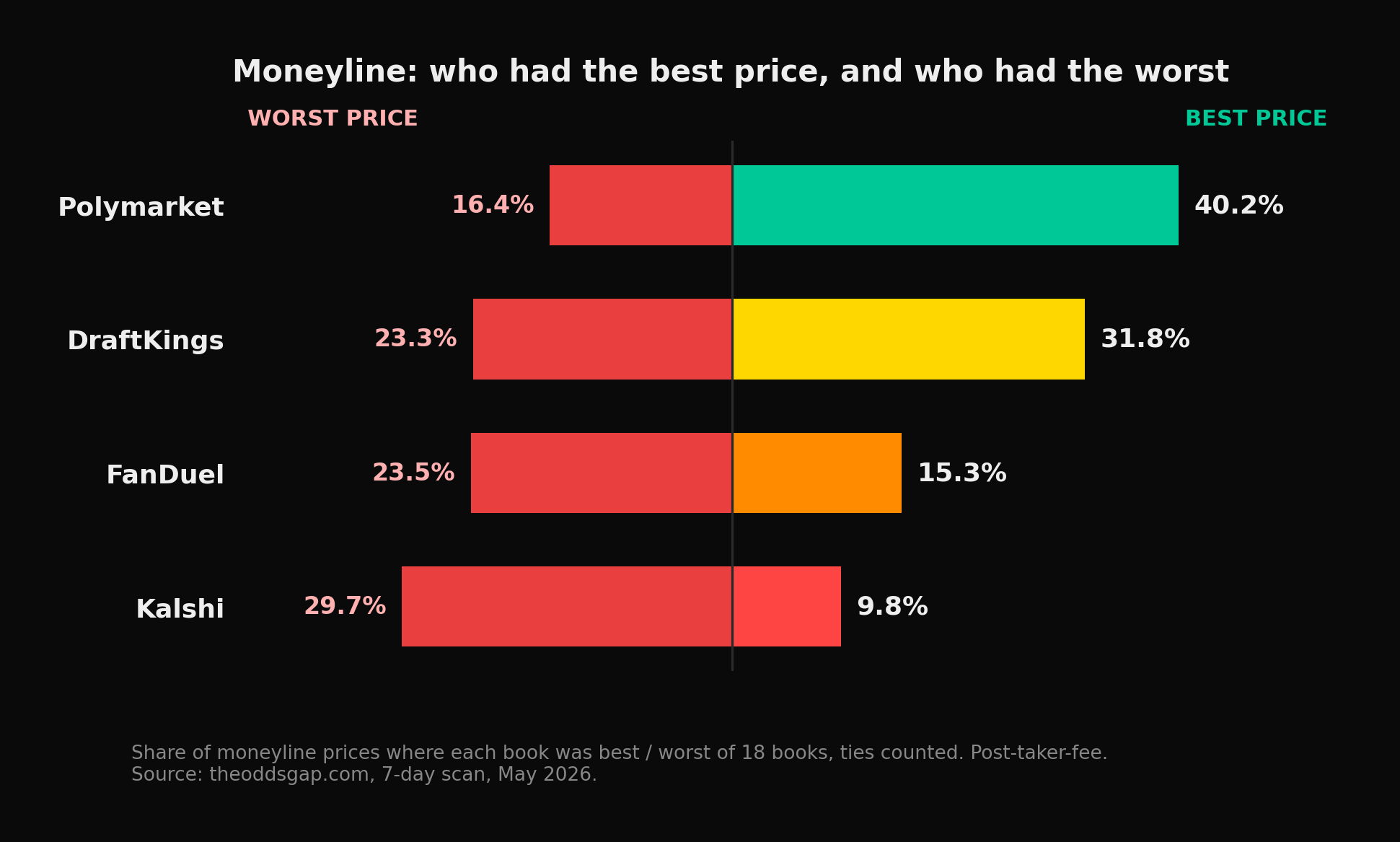
Polymarket was not just the most likely to be best. It was the least likely to be worst, posting the worst moneyline price only 16.4% of the time. Kalshi was the mirror image: best just 9.8% of the time and worst 29.7% of the time, more often than any of the four. An exchange with no embedded vig landing at the worst price nearly a third of the time sounds wrong until you account for the fee, which we come back to below.
DraftKings took spreads and totals
On spreads and totals the picture flips. DraftKings had the best spread price 65.0% of the time and the best total price 68.8% of the time, and on both markets it was not close. Polymarket was a clear second at 47.5% and 56.3%. FanDuel and Kalshi trailed: FanDuel at 19.5% and 14.9%, Kalshi at 8.3% and 8.0%.
Spreads and totals are a different kind of market. The standard price is -110 on both sides, a tight hold split evenly, and books compete by shading that number a point or two rather than by moving the line itself. Over this stretch, DraftKings shaded in the bettor's favor more often than anyone else.
One honest caveat, and it matters most on these two markets. Best-price share counts ties. When a dozen books all post the standard -110, every one of them is credited as best. Spreads and totals bunch like that constantly, the whole sportsbook field landing on the same number. When the field is fully tied, every book is at once the best price and the worst, which is why DraftKings shows up at the worst spread and total price almost as often as the best. A prediction market quotes its own precise price and stands alone, scoring only when it genuinely leads. That herd effect lifts the sportsbooks on spreads and totals more than it lifts Polymarket or Kalshi. DraftKings was at the best price most often, and that is real, but the true gap between it and Polymarket on these markets is narrower than a 65% to 47.5% split suggests. The moneyline, where prices spread out and books bunch far less, is the cleaner read.
Where FanDuel and Kalshi landed
FanDuel was the quiet story of the week: never the best, never the worst, mid-pack on all three markets. Best-price shares of 15.3%, 19.5%, and 14.9% put it between eighth and twelfth of the eighteen books. FanDuel is the most-used sportsbook in the country, and nothing here says it is a bad product. It says that if you bet at FanDuel and only FanDuel, you are leaving the best price on the table most of the time. That is true of almost any single book.
Kalshi is the harder story, because we published a different one about it two weeks ago. That post found Kalshi led the moneyline, and against the field at the time, it did. What changed is Polymarket. When that post ran, Kalshi was the only prediction market in our scan and had the no-vig exchange price on the moneyline to itself. Polymarket joined in mid-May and now leads the moneyline outright at 40.2%. Two exchanges are splitting what one used to hold alone. The earlier post also covered a thirty-day window, where this one is a seven-day snapshot. Measured here, after fees, Kalshi finished last of the four on every market this week, between twelfth and fifteenth of all eighteen books.
That is not a reversal of the structural point. Kalshi still has no vig embedded in the line, and that still matters. But the structural argument and the question of who posted the best price this week are two different questions. The honest answer to the second one, right now, is not Kalshi.
Vig, taker fees, and maker fees
Every number above is post-fee, so it is worth being precise about what the fees actually are.
Traditional sportsbooks charge vig. It is the gap between the price you get and the true odds, built directly into the line, and you pay it on every bet whether you win or lose. A standard -110 / -110 market carries roughly 4.5% of vig. FanDuel and DraftKings both run around 4.7% to 4.8% on a typical two-way market. There is no way to opt out. The line is the line.
Exchanges work differently, and the difference is the split between makers and takers. A taker crosses the spread and fills immediately. A maker posts a limit order at a chosen price and waits for someone else to fill it. Takers pay a fee. Makers pay much less.
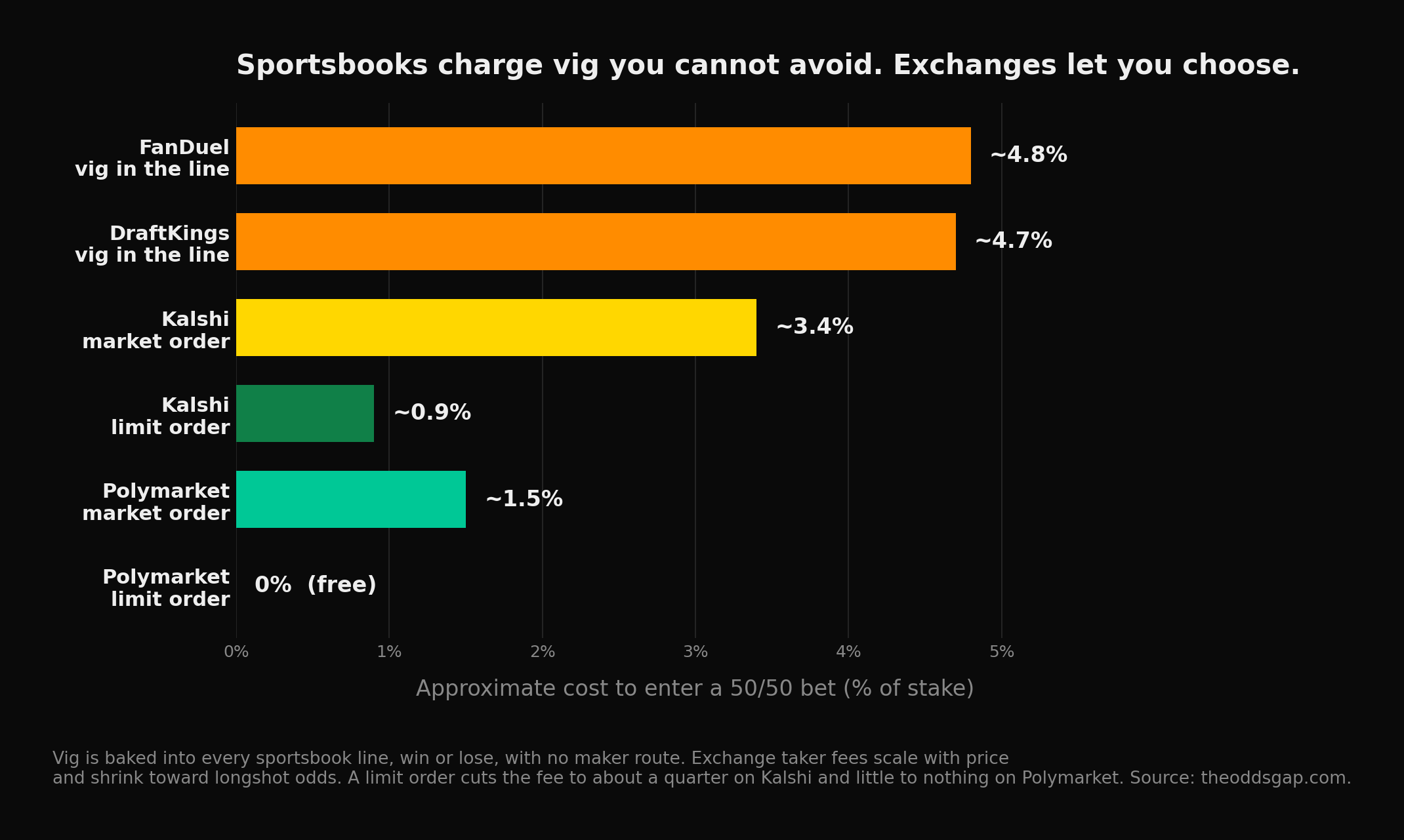
Kalshi charges takers a per-contract fee of about 7 × P × (1 − P) cents, where P is the contract price in dollars. On a coin-flip contract that is about 1.75 cents, shrinking toward longshot prices, which comes to roughly 3.4% of your total outlay on a 50/50 bet. A maker who posts a limit order instead pays a quarter of that, roughly 0.9%. Polymarket charges takers a smaller fee, roughly 1.5% of the wager on a coin-flip price at the schedule in force during this window, lower on favorites and higher on underdogs. Its limit orders are free or close to it. Update, July 2026: Polymarket has since raised its sports taker feeRate from 0.03 to 0.05, which puts the coin-flip cost at roughly 2.5% of the wager. The live boards on this site already price at the new schedule; the figures in this post reflect the fees in force when the data was collected.
This is the maker and taker point, and it is the single most important caveat for reading this post. Every best-price number above is a taker number. It assumes you hit the price the moment you see it. A patient bettor who posts limit orders pays a fraction of that cost, roughly a quarter of it on Kalshi and little to nothing on Polymarket, so both exchanges would score better than the figures here show. We do not yet publish a clean maker best-price share, so treat the exchange numbers as a floor rather than a ceiling. The sportsbook numbers have no such upside. There is no maker order at FanDuel.
One game, both sides
Numbers land better attached to a real bet. Here is one moneyline from the board on May 21, 2026.
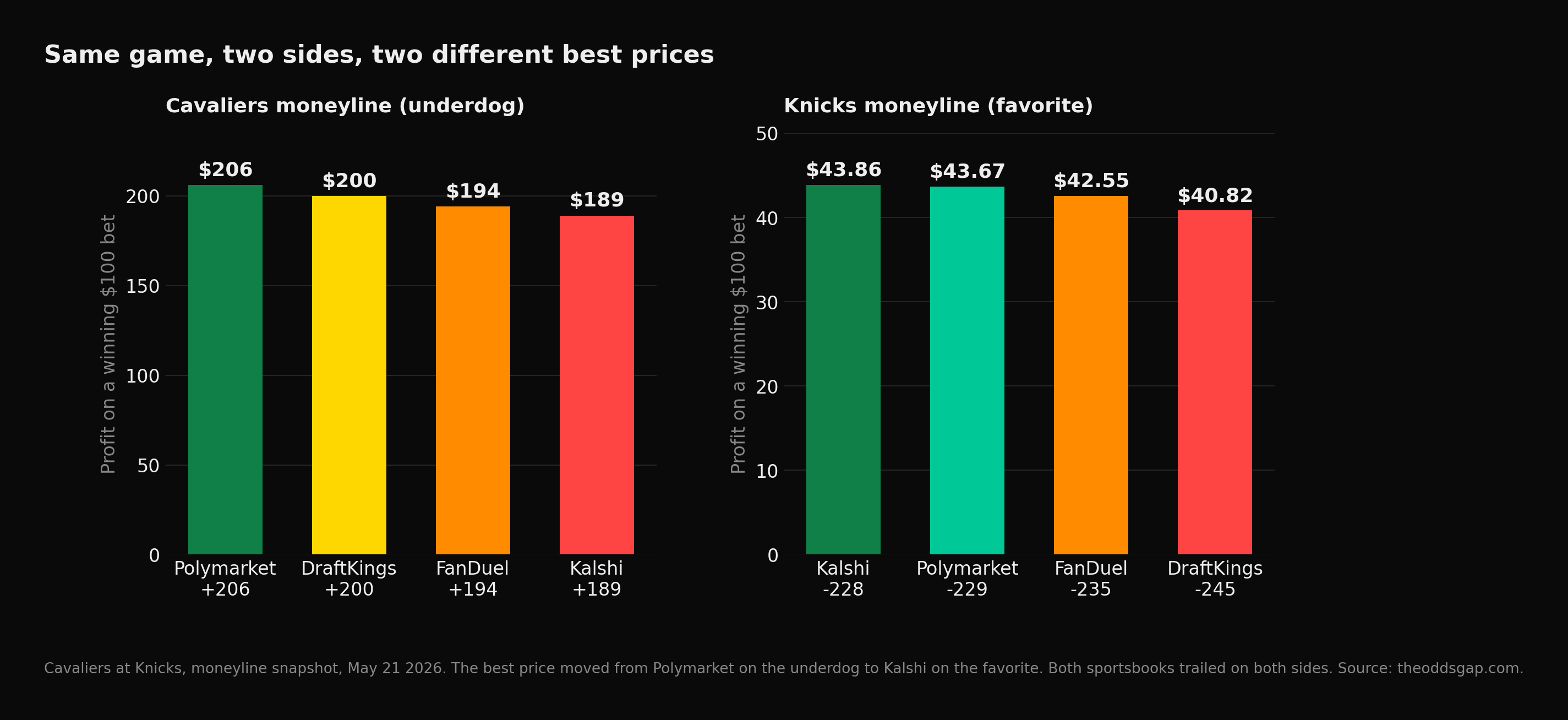
Cavaliers at Knicks. On the Cavaliers, the underdog, Polymarket paid +206, DraftKings +200, FanDuel +194, and Kalshi +189. A $100 winning ticket pays $206 at the best price and $189 at the worst, a $17 swing for clicking a different logo.
Then the same game, the other side. On the Knicks, the favorite, the order completely reorganizes: Kalshi -228, Polymarket -229, FanDuel -235, DraftKings -245. The book that paid the worst on the underdog, Kalshi, paid the best on the favorite. The book that was strong on the underdog, DraftKings, was dead last on the favorite.
One game is not a trend, and the seven-day data above is the trend. But the game shows the mechanism behind it. The best price is not a property of a book. It is a property of a book, a market, and a side, all at once. No shortcut survives contact with the actual board.
What to do with this
- Shop every market separately. The book that wins your moneyline is probably not the book that wins your total. Treating any one book as the default hands back the edge on the other two markets.
- Use the data, not the brand. Polymarket led moneylines this week. DraftKings led spreads and totals. Those are this week's facts, and they will move. The Odds Gap re-scans every minute on the live board during the beta, and hourly on the free board, for exactly that reason.
- Keep more than one account. Beyond price, different books own different things: player props, alternate lines, parlay mechanics, promotions, and the simple ability to get a bet down when one venue is slow or thin. Price is one input. It is the one this post measures, and it is not the only one that matters.
The Odds Gap exists to make this take three seconds instead of three minutes. Every market, every book, side by side, refreshed every minute on the live board during the beta and hourly on the free board.
See today's board
Live best-price share across every book The Odds Gap tracks, refreshed hourly from 7am to 9pm ET. The numbers in this post have already moved.
Open Book Comparison →
Figures in this post come from The Odds Gap's book-stats data for the seven completed ET days ending May 20, 2026. Best-price share is the share of logged prices where a book was best, or tied for best, of the eighteen books tracked, counting both sides of every market. Kalshi and Polymarket prices are fee-adjusted using each exchange's taker schedule as of the collection window (Polymarket's sports feeRate has since risen from 0.03 to 0.05). Sample sizes vary by book and market: the sportsbooks logged several times more prices per market than the two exchanges over this window, and Polymarket's totals market is the thinnest sample here, so weight it most cautiously. Live data is at /books and /gaps; methodology at /methodology#prediction-markets.
This post updates an earlier one, Kalshi Wins the Moneyline. The structural argument there still holds. The best-price-share figures here reflect a more recent seven-day window, fee-adjusted, with Polymarket included in the field.