
You're Overpaying on Every Bet. Here's How to Fix That.
I'm Dan. I built The Odds Gap, a free sports betting odds comparison and tools site, and I have been building it in public right here, 30+ features deep now, with real help along the way. A shoutout to @TheRealMello for a lot of sharp insight on what to build. So consider this less a hello and more a proper introduction, and the single most important thing I have learned building this. It is the whole reason the product exists.
The number on the screen is not the price.
When people compare sportsbooks, they read the odds and pick the biggest number. But that number quietly hides costs that make a fair comparison almost impossible by the eye test. A few of them:
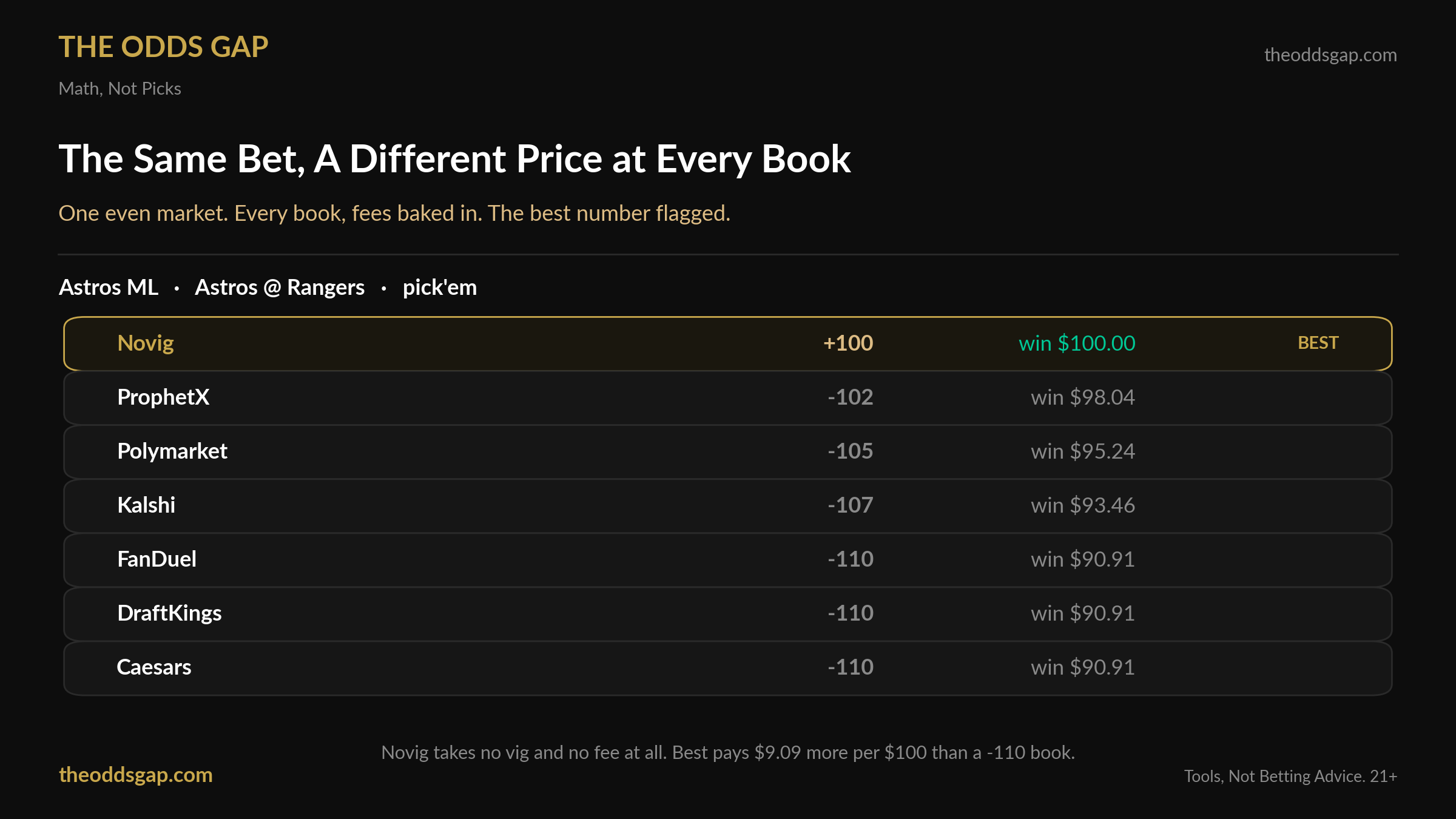
The Vig, the Juice, the Sportsbook's Cut
A -110 line looks like a coin flip. It is not. It is a coin flip with the book skimming about 4.5% off the top, win or lose, whether you notice it or not. 4.5%! I know plenty of boomers that let their money sit all year in bonds for a 4.5% return. I know these aren't sportsbooks' clientele, but that's probably partially why most look past it. They aren't necessarily focused on saving every little bip or how that can compound to increased profit over time. Most gambling on sports are looking for a quick buck, a lotto ticket, a way out of the rat race, or maybe just a quick fix of adrenaline. Whatever the reason may be, the majority of sports bettors start off behind in the race. Back to the analysis - two books can post the same -110 and still not be the same bet once you look at both sides of the market.
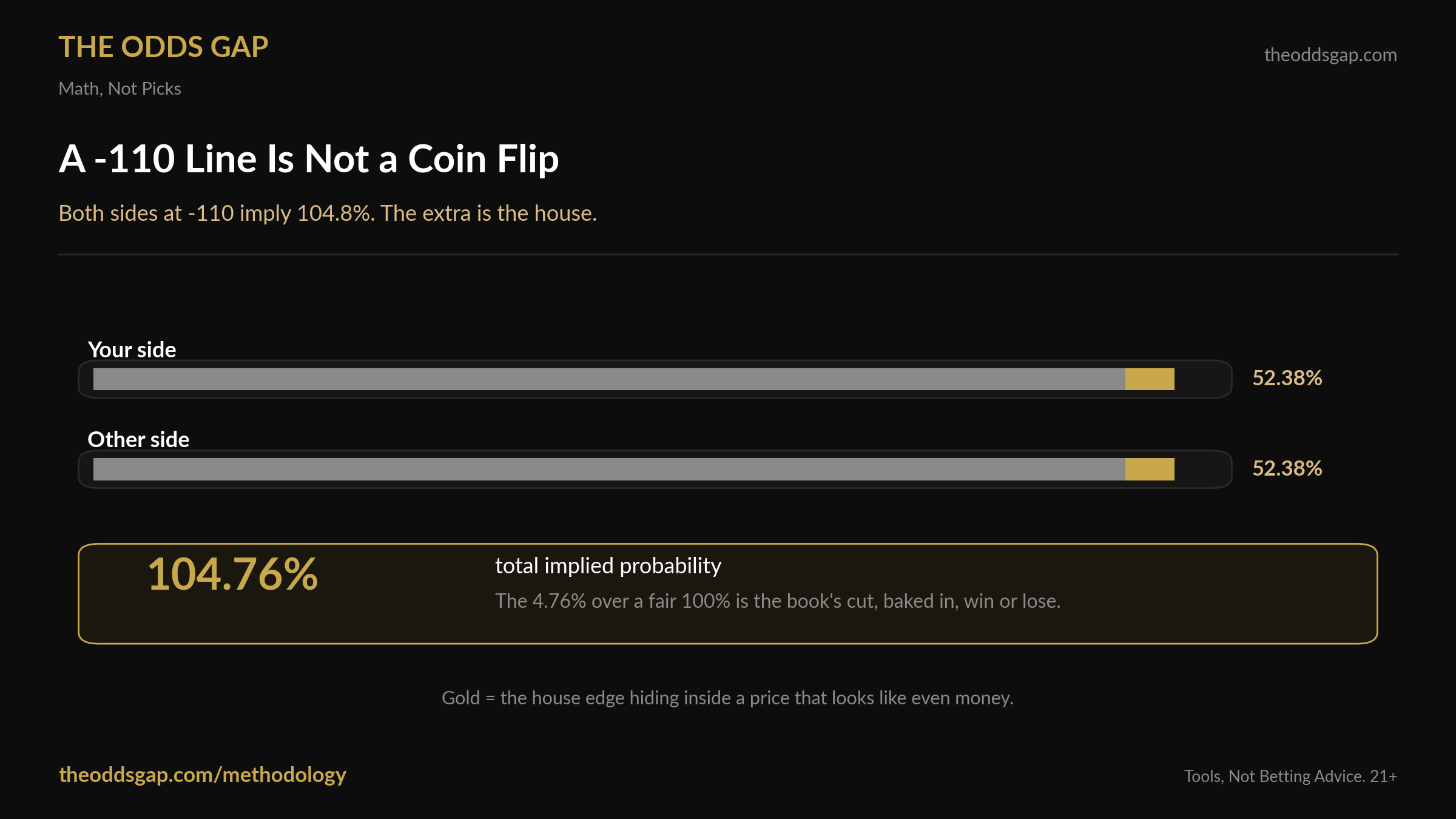
The Exchange Fine Print
Prediction and betting exchanges like Kalshi, Polymarket, Novig and ProphetX often show a better raw number than any sportsbook, because there is no vig baked in. But each one takes its cut differently, and that decides who is actually cheapest:
- Kalshi charges a per-contract taker fee, roughly 7 × P × (1 − P) cents, about 1.75 cents on a coin flip. A price that looks great before the fee can finish behind a sportsbook after it. Let's be honest - the majority of sports bettors aren't placing limit orders and saving on taker fees. The odds Kalshi shows are not THE odds you actually get.
- Polymarket also runs no vig, but it charges a per-trade taker fee just like Kalshi, currently about 2.5 cents on the dollar on a coin flip and steeper the longer the shot. Same problem: the raw price you see is not the price you actually get, so we bake the fee in before we show it. Even after that, Polymarket is the exchange that most often posts the best moneyline of the majors in our data, which is why it earns its spot. The one real tradeoff is breadth: it is mostly game lines with light prop coverage, so it wins you the best number on a marquee moneyline more than it covers your whole card.
- Novig charges no vig, and no fee at all on a pre-game straight trade. It does charge on parlays and on live in-game trades, which it did not when this was first written. In my matched-line data, where I only count spots where every book quoted the exact same line, Novig usually posts the best price of anyone. The catch is liquidity and market offer breadth. It is often the best number you cannot actually get filled at real size and they don't have nearly the number of betting options that traditional sportsbooks do.
- ProphetX is a newer CFTC-regulated exchange with better breadth than Novig, more markets actually quoted, but the same liquidity reality and a 2% commission on your net winnings for straight bets, zero on parlays. On a coin flip it sits around -102 where a sportsbook is -110.
There is a second way the number on your screen is not the price, and it is worse than a fee because nothing about the quote looks wrong. The offer has to actually exist. This site published exchange prop prices for months with no offer underneath them, and the account of it is the exchange price autopsy, which found 19 percent of quoted exchange prop sides were derived from the opposite side of the order book rather than read from a real offer. A fee you can subtract. A price nobody is offering you cannot.
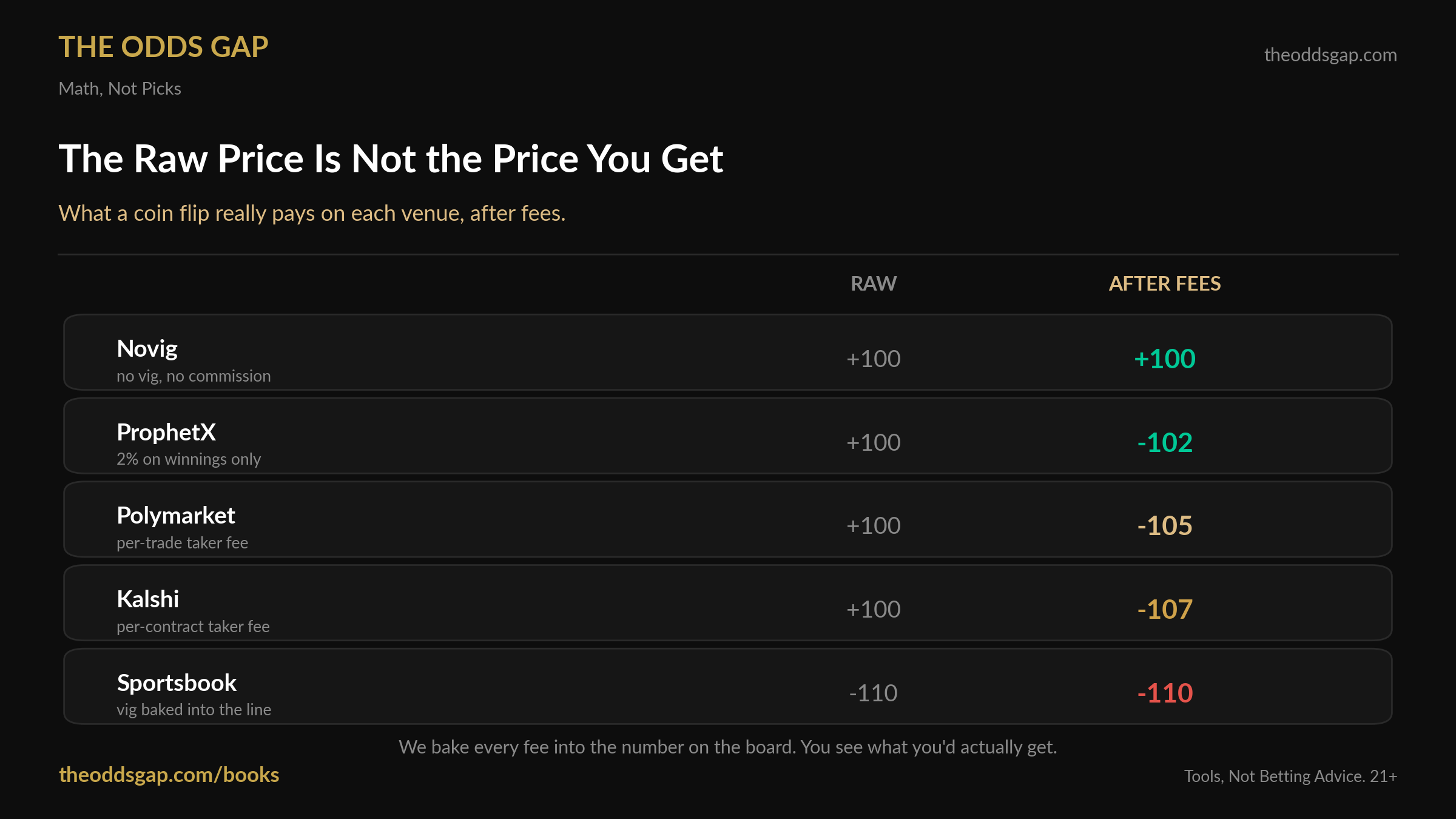
So the honest ranking flips depending on what you care about. Best posted price is often Novig. Best price you can actually bet at size is frequently a sportsbook. That tension is invisible until a tool puts them side by side, post-fee, and tells you.
Which is exactly what The Odds Gap does. Every exchange price on the site is shown after its fee, not before it. When you look at Kalshi or Polymarket on our board, you are looking at the number you would actually get if you took it right now, not the shiny number the exchange wants you to see. You never have to do this math. We already did it, on every line, every scan.
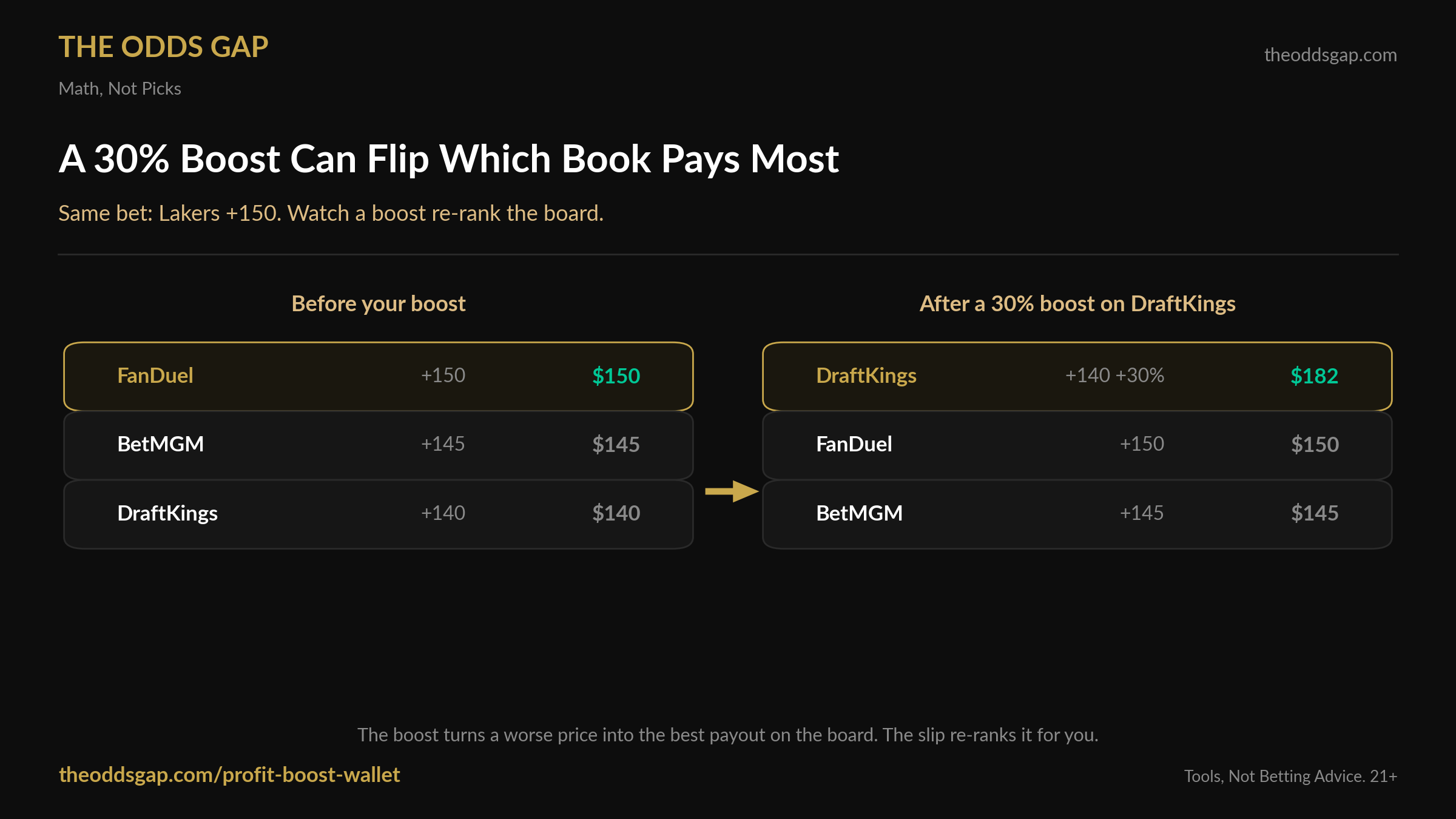
Profit Boosts, the Value People Leave on the Table
Sportsbooks hand out profit boost tokens, a 30% boost here, a 50% one there, and most people forget they have them or misjudge what they are worth. A boost can quietly make a worse-priced book the best book for one specific bet. So I built a Profit Boost Wallet: you save your boosts with the fine print (book, max bet, boost %, bet type, minimum odds, expiration date, etc.), and the bet slip applies the eligible ones automatically and re-ranks which book pays the most for your exact bet.
The Market Moves, and We Keep the Whole Tape
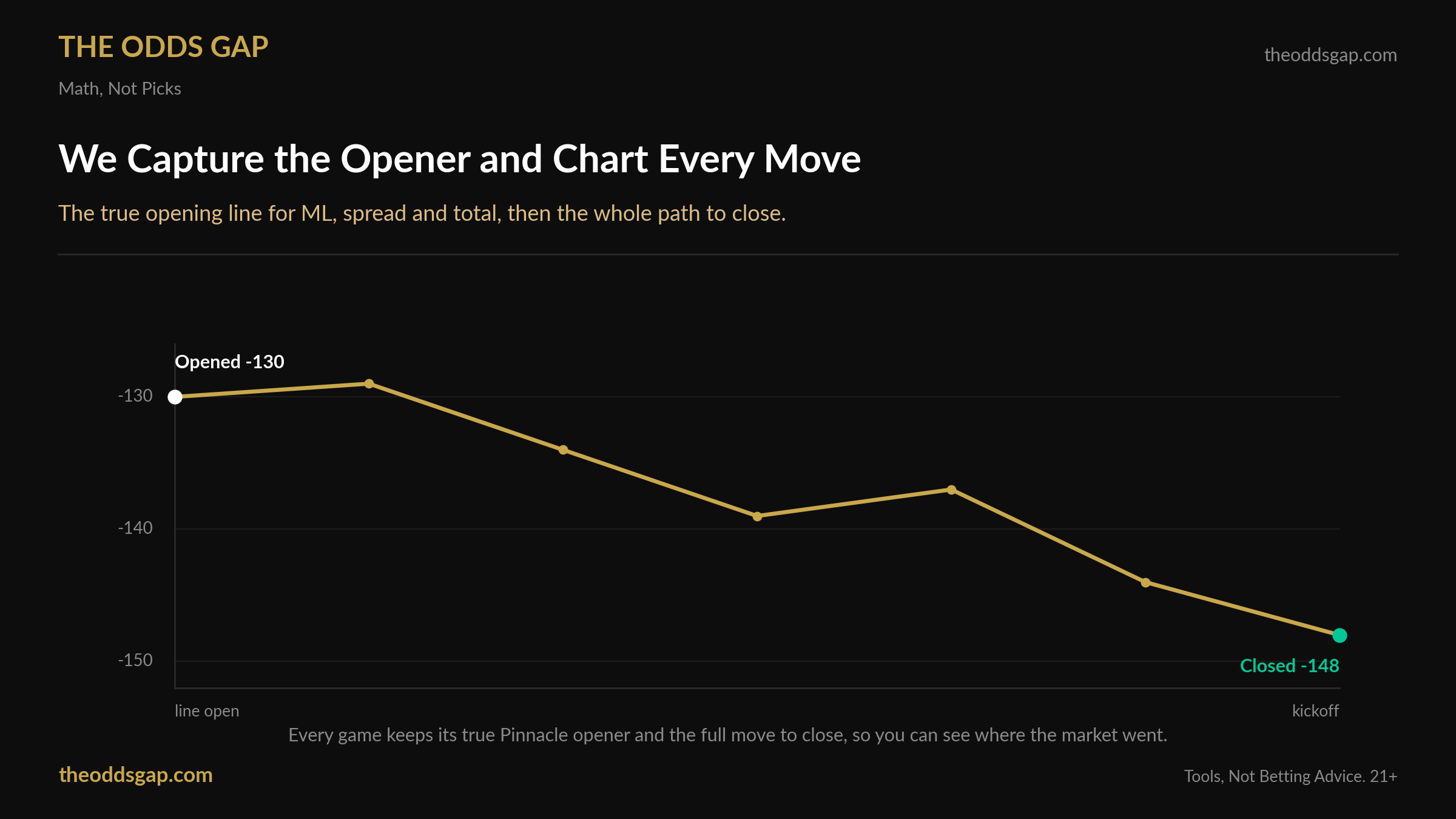
Sharp money moves lines all day, so a number only means something next to where it started. For every game we capture the true opening line for the moneyline, spread and total, then chart the full path from open to close. You can see where a number opened, how far it traveled, and whether the move went with you or against you. We also surface the hold on any market, the book's built-in cut, so you always know the size of the tax before you bet.
The Hedge Finder Does the Hard Part for You
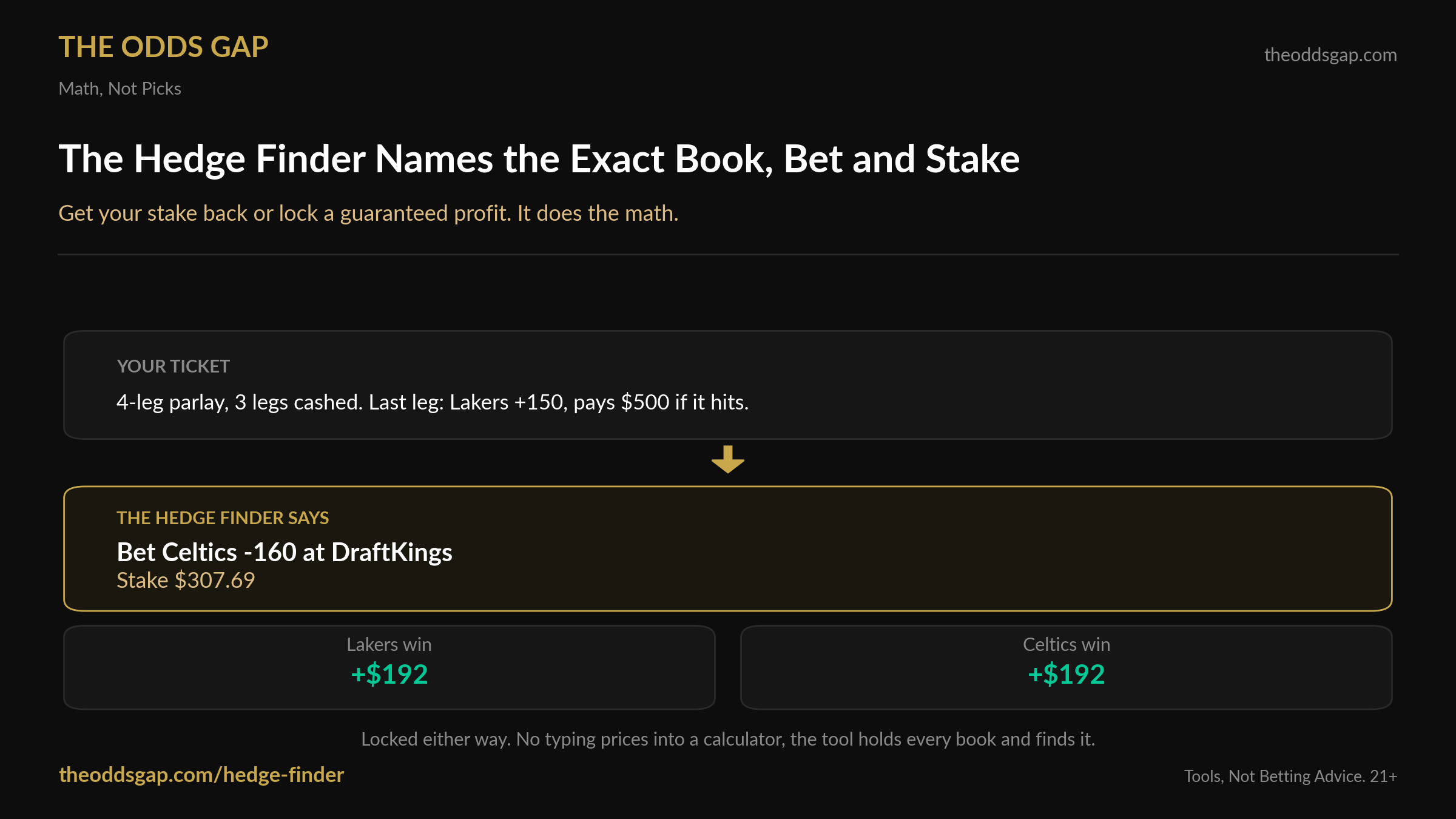
Say your parlay is one leg from cashing, or a book handed you a free bet, or you just want your stake back with a guaranteed profit locked in. Tell the Hedge Finder your bet and it names the exact book, the exact price, and the exact stake to place, and shows the profit you lock either way. It runs the scenarios you actually face: hedge any open bet, convert a free bet to cash, cash out a profit or odds boost, clear a no-sweat bet or rollover requirement, protect a parlay leg, or back the rest of a futures field at each outcome's best price. It already holds every book's number, so it finds your hedge instead of making you type prices into a calculator.
And the Rest of the Toolkit
The core is the Line Shop: live prices from 19 sportsbooks and 4 exchanges on one board, the best number flagged on every moneyline, spread, total and player prop, fees already baked in, with a live in-play board that rescans every book every minute during games.
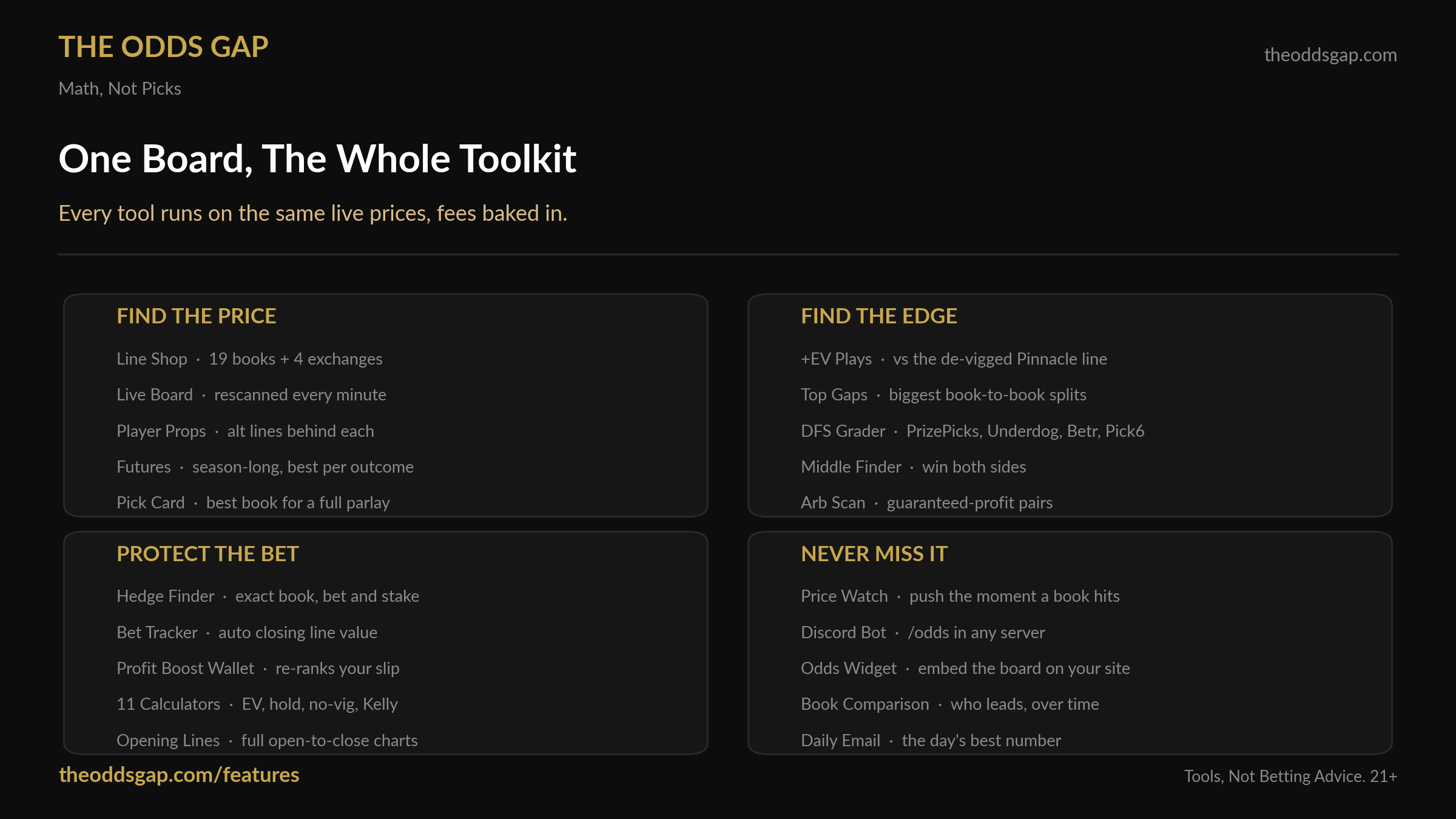
Around it, the +EV Plays board flags every price that beats the de-vigged Pinnacle fair line, across moneylines, spreads, totals and player props, ranked by edge and graded win or loss on a public record. The Book Comparison page shows how often each book actually posts the best price, by sport and market, tracked over time. There is a Bet Tracker that logs your closing line value automatically, a DFS board that grades PrizePicks, Underdog, Betr and Pick6 against the real market, a Middle Finder and Arb Scan for guaranteed-both-sides spots, a Futures board, 11 calculators including EV, hold and no-vig, price-watch push alerts the moment any book hits your number, a Discord bot that drops the odds into any server, and an embeddable odds widget for your own site.
Every piece exists for the same reason: you cannot line shop honestly by eye. The fair comparison means stripping the vig, applying each exchange's fee, accounting for whether you can actually get filled, and folding in your own boosts, all at once, on every line, in the seconds before a game. That is arithmetic a human is not going to do. So the tool does it.
I do not sell picks and never will. I only tell you where the same bet pays more. Math, not picks. That is the whole company.
I am going to keep posting the math here, the gaps, the fees people miss, the spots where the number lies. If that is your kind of thing, follow along. And if there is a betting-math thing you wish a tool just showed you, tell me. I will build it.
Dan
See the Real Best Price on Your Next Bet
Live odds from 19 sportsbooks and 4 exchanges on one board, every fee already baked in. Free, and a free email unlocks the 60-second live board.
Open the Line Shop →Fee figures reflect each venue's public schedule as of July 2026 and the way The Odds Gap displays exchange prices: after fees, directly comparable to a sportsbook line. Kalshi and Polymarket charge per-trade taker fees; ProphetX charges 2% on net straight-bet winnings and zero on parlays; Novig charges no vig and nothing on a pre-game straight trade, but does charge on parlays and on live in-game trades. Coin-flip figures are illustrative. Matched-line and best-price claims come from The Odds Gap's own scan data. See the methodology for how we bake in exchange fees, and the Book Comparison page for the live board. Always verify odds before placing any bet.