
Tuesday Tool Series #5: DFS Pick'em Edges
Tuesday tool series, article 5 of 19. The tool: DFS Pick'em Edges at theoddsgap.com/dfs
DFS Pick'em Edges: How to Tell Which PrizePicks and Underdog Lines Are Actually Beatable
Every number was pulled live off theoddsgap.com at 8:52 AM ET on September 1, 2026. Nothing is invented.
1. The Problem
Football is back, and so is the part of the season where your group chat fills up with screenshots of six-pick entries. Pick'em is fun. It is also the only form of betting most people do where the price is completely invisible.
On a sportsbook you can see you are laying -145. You may not like it, but you know it. On a pick'em app you see a number, a More button, a Less button and a payout. Two picks pays 3x, six picks pays 37.5x, and nowhere does it tell you what chance either side has. So most entries get built the same way: you know the player, the line looks low, you tap More. Six times.
The apps are not doing anything underhanded. They post a number and a payout, same as everyone. But they are not obligated to show you the market's opinion of that number, and the market has one. It is free to look at. Almost nobody looks.
2. What the Tool Does
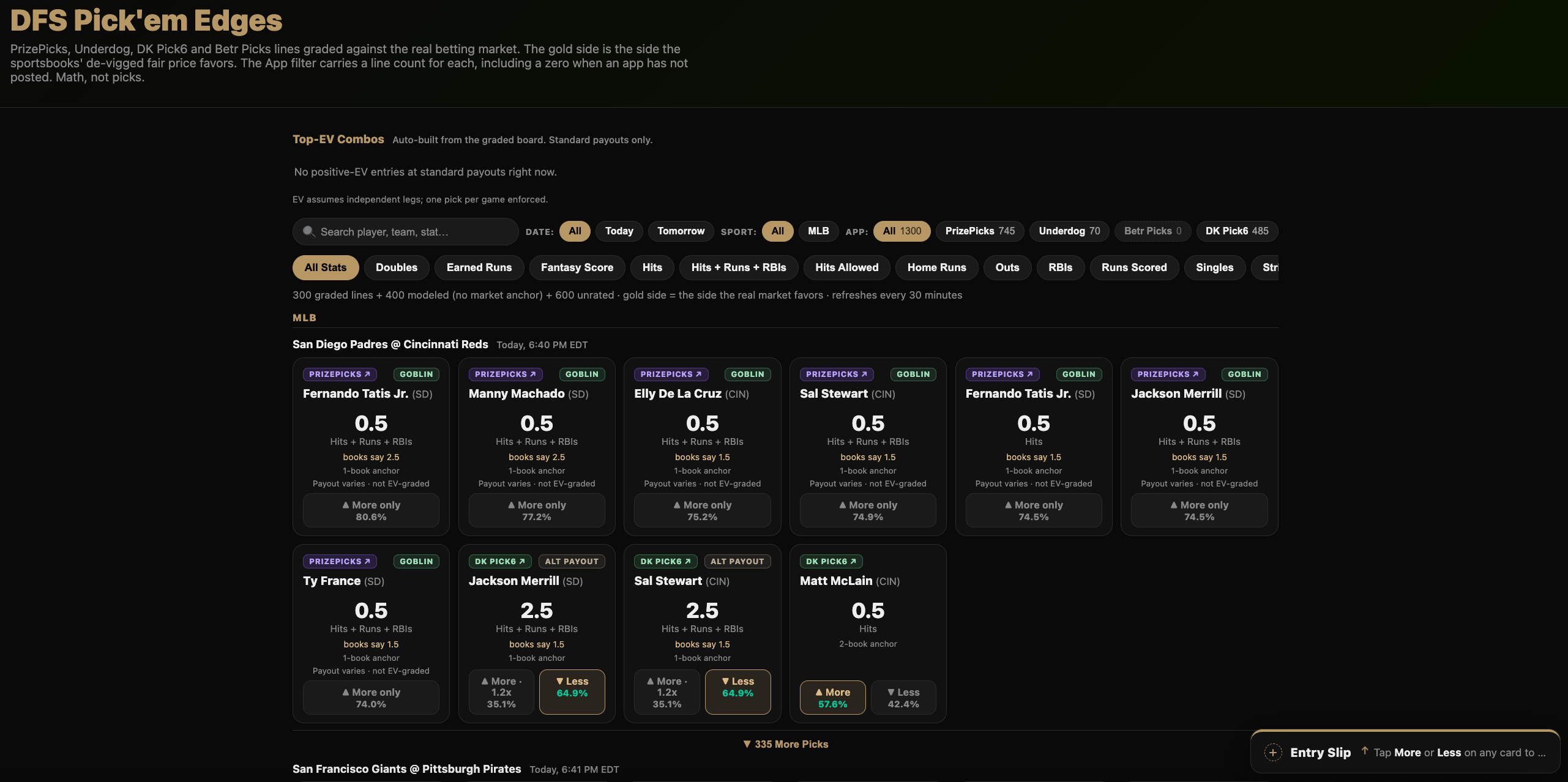
The DFS Pick'em Edges board takes every pick'em line posted by PrizePicks, Underdog and DK Pick6, finds the same player and stat at the same exact number in the sportsbook market, strips out the vig, and gives you the fair probability of each side. It does not tell you what to bet. It tells you which side the market's money is on, and by how much.
The output on each card is one number: a fair percentage, in gold. That is the starting point, not the answer. The market's number and our record of how those numbers actually perform are two different things, and the gap between them is the reason this article exists.
3. A Real Line, Graded, Start to Finish
Ceddanne Rafaela, Hits plus Runs plus RBIs, Seattle at Boston, first pitch 6:46 PM ET. DK Pick6 posted it as a standard pick at 1.5, and at the 8:52 capture PrizePicks had a standard 1.5 too.
Seven venues quoted both sides of that exact number. Ranked best price to worst on the Over:
| Venue | Over | Under | Hold |
|---|---|---|---|
| Kalshi | +113 | -142 | 5.6% |
| ProphetX | +112 | -147 | 6.7% |
| DraftKings | +109 | -145 | 7.0% |
| Hard Rock Bet | +100 | -130 | 6.5% |
| Caesars | +100 | -134 | 7.3% |
Two offshore venues, Bovada and Fliff, also quoted both sides and sit inside the median below, but we do not rank offshore books anywhere on the site. The median is 55.9% either way. Kalshi and ProphetX are affiliate partners; prices come from the same scan for everyone and a partner never gets a ranking boost (disclosure).
Read the hold column first. Every one of those two-sided quotes adds up to more than 100%, and that margin has to come out before a price means anything.
Strip it venue by venue with the power method (more below) and the fair chance of the Under runs from 56.4% at ProphetX down to 53.4% at Hard Rock Bet. Take the median across all seven quotes and you get 55.9% for the Under, exactly what the board shows on the card.
Now the part most people stop at. Against PrizePicks' verified power play payouts, here is what each leg has to hit to break even:
- 6-pick at 37.5x: 54.7%
- 5-pick at 20x: 54.9%
- 3-pick at 6x: 55.0%
- 4-pick at 10x: 56.2%
- 2-pick at 3x: 57.7%
Read those two numbers together and 55.9% looks like a small edge in a six, five or three-pick entry. Six legs like that at 37.5x prices out around +14%.
That conclusion is wrong, and our own data is what says so.
We settle every prop leg we grade and keep the record. Across 6,327 of them, lines the market priced around 55.9% did not win 55.9% of the time. They won about 51.5%. The board carries a correction built from that record, applied one way only: it can pull a number down, never push one up. Here the haircut is 4.4 points.
Put 51.5% through the same five formats and every one is negative. The six-pick that read +14% on the market number reads about -30% on the graded one. No entry size rescues it.
So the honest read is: the market leans Under, and not by enough to beat any standard pick'em payout once priced off what these grades actually did. The card shows 55.9% because that is what the market says. The Top-EV Combos strip prices legs at the calibrated number instead, which is why a line like this never appears there.
Football note, honest rather than convenient. At capture the market already carried about 250 NFL prop records for week one, but the apps had not posted pick'em lines against them yet, so the graded board was all baseball. Football fills in as the apps post, usually much closer to kickoff. A quarterback passing yards line grades exactly the way Rafaela's did, calibration and all.
4. Demons and Goblins, and What They Really Cost
On that same Rafaela market at 8:52, PrizePicks had a standard line at 1.5, a goblin at 0.5, and demons at 2.5, 3.5, 4.5 and 5.5. A goblin moves the number down so the More is easier and pays less. A demon moves it up so the More is harder and pays more. Both are More-only, and the rungs move fast: by 9:18 the 1.5 was no longer standard.
The board grades rungs the same way it grades a standard line. Two from the 8:52 capture:
- Goblin. Manny Machado, Hits, San Diego at Cincinnati, line at 0.5. Fair chance the More hits: 71.2%.
- Demon. Sal Frelick, Hits plus Runs plus RBIs, Milwaukee at Chicago, line at 1.5. Fair chance the More hits: 47.6%.
Neither is an edge or a leak until you know the payout, and PrizePicks does not publish demon and goblin multipliers anywhere we can read them. So the board tags them "Payout varies, not EV-graded" and gives the hit probability only. It will not guess the other half.
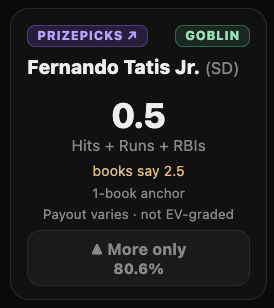
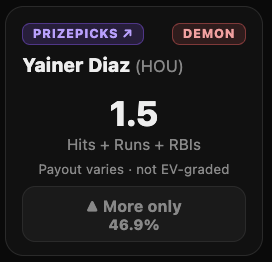
The rest is arithmetic. A goblin at 71.2% needs about 1.40x to break even, a demon at 47.6% about 2.10x, and the section 3 calibration caveat applies to both.
5. How to Use It
- Filter to your app and today's slate with the pills at the top.
- Read the gold side, not the player name. Gold is the side the de-vigged market favors. If it says Less and you wanted More, that is the board telling you something.
- Check the anchor note. Cards graded off one or two two-sided quotes are tagged "1-book anchor" or "2-book anchor". Still a real market read, just a thinner one, and thin ones never make the combos.
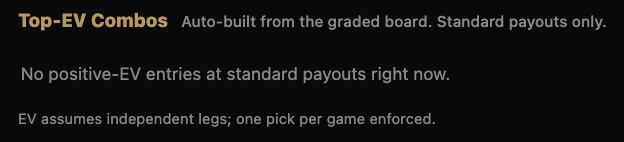
- Start at the Top-EV Combos strip, not the cards. Combos are the only place legs are priced at the calibrated number, so they are the honest version. Two caveats: the strip only builds 2 and 3-pick entries, and it is often empty. It was this morning, because the best standard leg graded 58.6% and a qualifying 3-pick needs about 59.1%. An empty strip means there is nothing worth playing, which is the right answer more often than anyone selling picks admits.
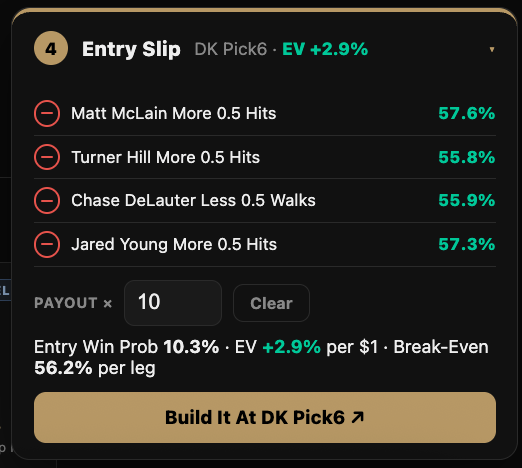
- Then build your own and type your payout. The slip returns combined win probability and EV, but prices a manually added leg at the card's market number, so it reads higher than the equivalent combo. Subtract roughly four points per leg in the mid-fifties.
6. The Math Behind It
Three steps. Match the exact bet, same player, stat and number. Remove the vig with the power method, which solves for the exponent making both sides sum to 100% rather than dividing each side by the total. Take the median, so one stale quote cannot drag the consensus.
Here, sportsbooks and the regulated exchanges (Kalshi, ProphetX, Novig) both count as anchors, because a pick'em number is often one no sportsbook posts at all. Our prop +EV badge stopped counting them in August, so the two surfaces answer "what does the market think" slightly differently. We call that an open question rather than a settled position, and /methodology measures how much it moves. On the Rafaela line: 55.9% with the exchange quotes in, 55.1% without.
Then the guards. On standard lines, anything above 65% is hidden as a data error, because a genuine 70% standard pick'em line does not exist. Demons and goblins are deliberately lopsided and run on a wider band, roughly 5% to 88%, which is why you see goblins in the eighties. Lines nothing quotes get a blue "Modeled" tag, capped at 62%, and never join the combos.
7. What This Does Not Do
This is the part nobody else publishes, so read it properly.
It does not know your entry is correlated. The combined win probability on a multi-leg entry is the product of the individual fair percentages, which assumes independence. Two picks from the same game are not independent: a quarterback going over on passing yards makes his receiver going over far more likely than the raw math says. The board enforces one pick per game in the combos for that reason, and labels a same-game pair in your own slip a Ceiling rather than an estimate. The true number is lower, by an amount we do not claim to know.
The card number is the market's, not ours. The gold percentage is the de-vigged market price, not adjusted for how our graded legs performed. Only the Top-EV Combos apply that adjustment, so a card and a combo can disagree about the same leg by around four points. When they disagree, trust the combo.
It does not price demons and goblins. Hit probability and stop, because the multiplier is not published. Anyone quoting an EV on a demon is filling in a number they cannot see.
It is a snapshot, and a short one. The Rafaela line had moved to 55.0% by 9:18 and the ladder around it reshuffled. Refresh before you build.
It cannot grade what nobody quotes. Fantasy scores, most 1Q splits and deep-bench players have no market anchor. Those get the modeled estimate or nothing, and we label which.
And it is not a pick. Math, not picks. A 55.9% side still loses 44.1% of the time. What you do with these numbers is yours.
See Today's Board
Every PrizePicks, Underdog and DK Pick6 line, graded against the de-vigged market and against our own record of how those grades performed.
Open DFS Pick'em Edges →Every price above is a real quote off the board, captured at 8:52 AM ET on September 1, 2026, with a follow-up read at 9:18 AM the same morning. Pick'em lines and their demon and goblin rungs move constantly, so always verify a line in your app before entering. This is a price comparison, not betting advice. Please gamble responsibly.