
Tuesday Tool Series #1: The Line Shop
The same bet pays different amounts at different books, and most bettors never check.
You like the Royals tonight. You open the app already on your phone, see +125, and bet it. It takes eleven seconds and it feels efficient.
Here is what those eleven seconds cost. At the moment you tapped, another book was paying +147 on the exact same Royals moneyline. Same team, same game, same result if it wins. Your $100 returns $125 in profit at +125. It returns $147 at +147. You gave up $22 for the convenience of not looking, and you will never notice, because the bet still won. Losing bets look identical everywhere. It is only the winners that quietly pay you less, which is exactly why nobody feels the leak.
This is not a rare pricing mistake you have to hunt for. It is the normal state of the market, on almost every game, every day. Books set their own prices, move them at different speeds, and carry different amounts of vig. The result is a spread of prices on every bet, and the only skill required to capture it is checking.
What the Line Shop does
The Line Shop at theoddsgap.com puts every major sportsbook's price for the same bet side by side, one row per game, with the best available price flagged. It covers moneylines, spreads, and totals across every active league on the board, and alongside the traditional sportsbooks it prices four prediction markets and exchanges: Kalshi, Polymarket, ProphetX, and Novig. Exchange prices are adjusted so they are comparable to sportsbook odds, not raw screen prices (more on that in the math section).
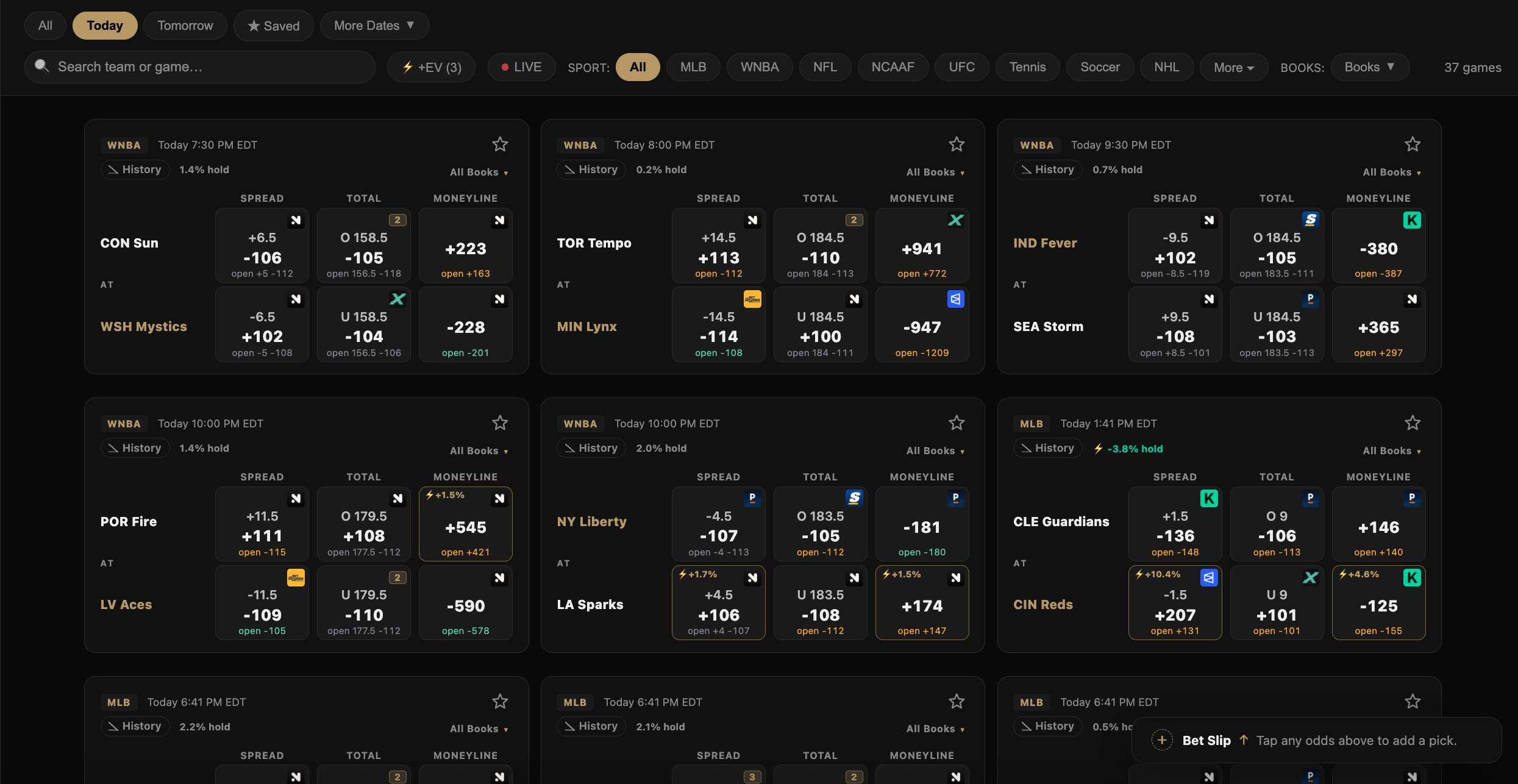
It refreshes continuously through the day, it is free, and it does not tell you what to bet. It tells you where the bet you already wanted pays the most. Math, not picks.
A real example: Royals at Twins, July 28
These numbers were pulled from the live board this morning, Tuesday, July 28, 2026, at 10:30 AM ET, for tonight's Royals at Twins game (7:41 PM ET first pitch). Twenty books were quoting the Royals moneyline. Here is the full ladder, best to worst:
| Book | Royals ML | Implied probability | Profit on $100 |
|---|---|---|---|
| Novig | +147 | 40.5% | $147.00 |
| ProphetX | +145 | 40.8% | $145.00 |
| Pinnacle | +144 | 41.0% | $144.00 |
| BetOnline | +140 | 41.7% | $140.00 |
| theScore Bet | +140 | 41.7% | $140.00 |
| LowVig | +140 | 41.7% | $140.00 |
| Polymarket | +140 | 41.7% | $140.00 |
| Bovada | +138 | 42.0% | $138.00 |
| FanDuel | +136 | 42.4% | $136.00 |
| BetMGM | +135 | 42.6% | $135.00 |
| DraftKings | +135 | 42.6% | $135.00 |
| Fanatics | +135 | 42.6% | $135.00 |
| Fliff | +135 | 42.6% | $135.00 |
| Hard Rock Bet | +135 | 42.6% | $135.00 |
| MyBookie | +135 | 42.6% | $135.00 |
| Caesars | +135 | 42.6% | $135.00 |
| Kalshi | +134 | 42.7% | $134.00 |
| BetRivers | +128 | 43.9% | $128.00 |
| Bally Bet | +125 | 44.4% | $125.00 |
| BetParx | +125 | 44.4% | $125.00 |
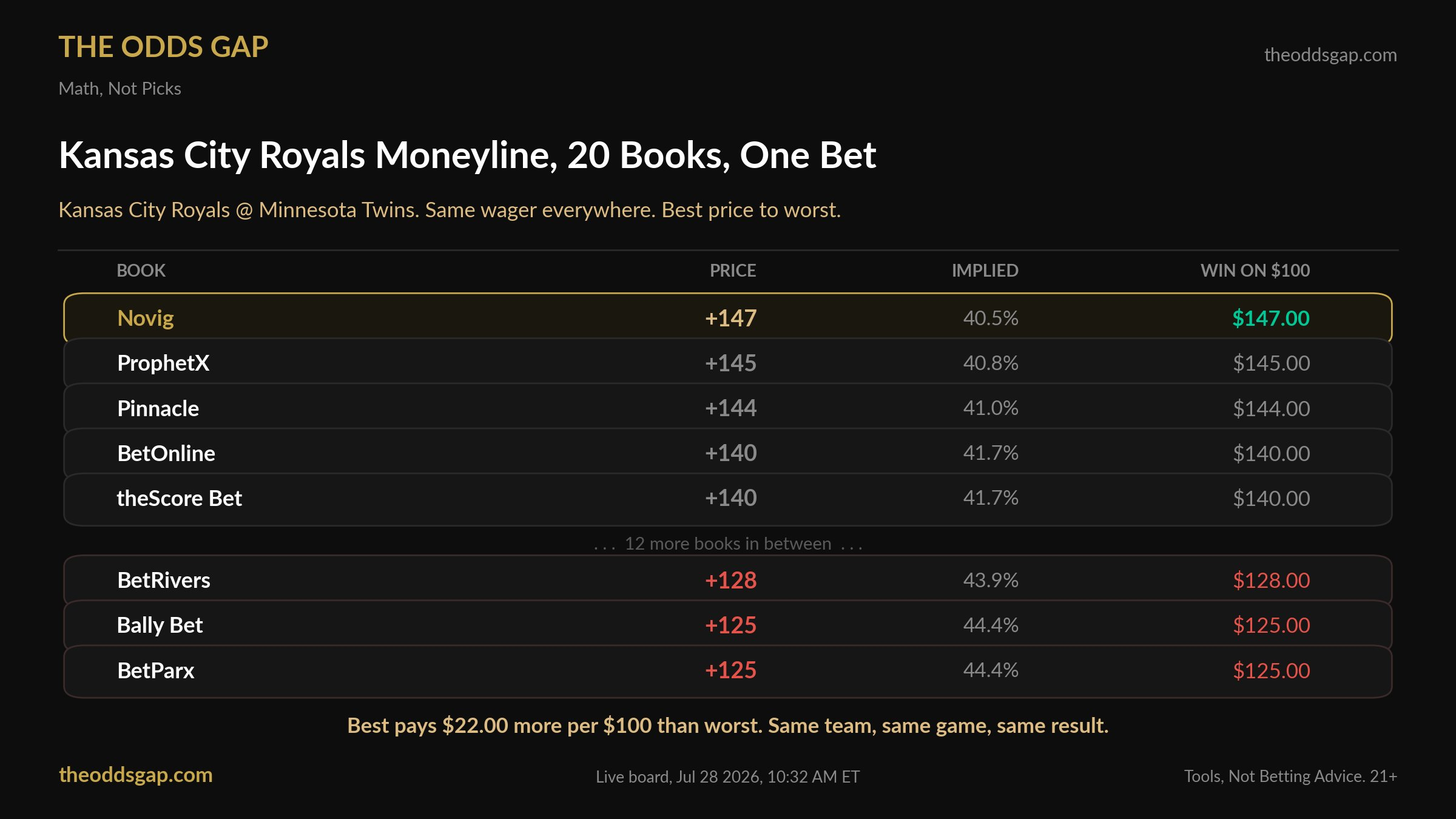
That is a 22 cent spread on one baseball game, top to bottom. In implied probability terms, the worst price charges you as if the Royals win 44.4% of the time while the best price charges 40.5%. That 4 point difference is pure price, not opinion. Nobody thinks the Royals are a different team at one counter than another.
Put dollars on it. A $100 bet at +147 profits $147 when it wins. The same $100 at +125 profits $125. Place a few hundred bets a season, give up even half this game's spread on average, and you have left hundreds of dollars on the table without making a single bad pick.
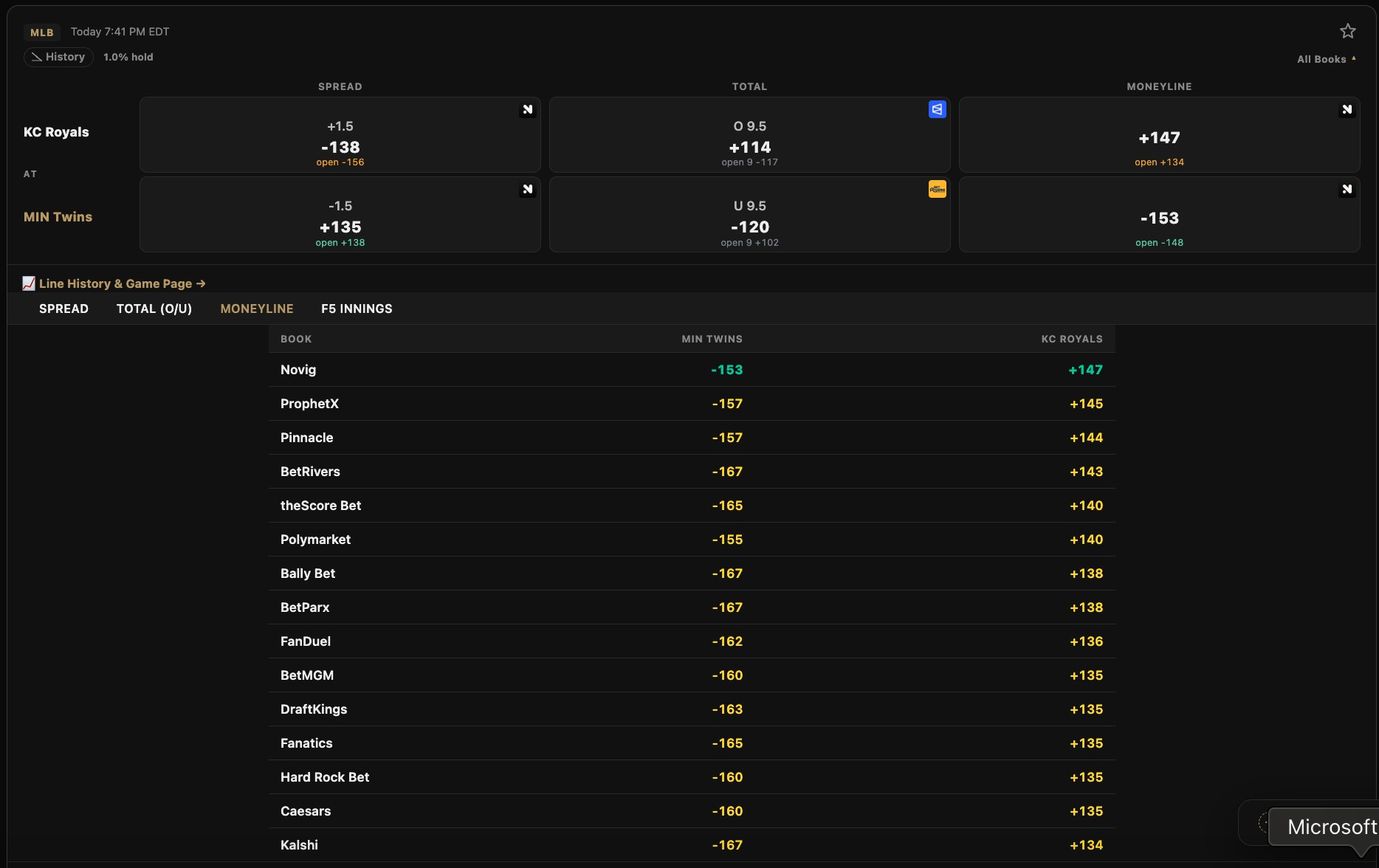
Now the part that matters more than the ladder itself. Look at the other side of the same game. The best Twins price was BetRivers at -152, then ProphetX -153, then Bally Bet, BetOnline, BetParx, LowVig, and Polymarket all at -155, down to -170 at the bottom. BetRivers paid the best Twins price on the board and the third-lowest Royals price. Bally Bet and BetParx sat at the bottom of the Royals ladder and near the top of the Twins one.
That is the real lesson. There is no book that is simply "the sharp one" or "the cheap one." Books lean, and they lean differently on each side of each game. Picking one book and trusting it is just a slower version of not checking at all.
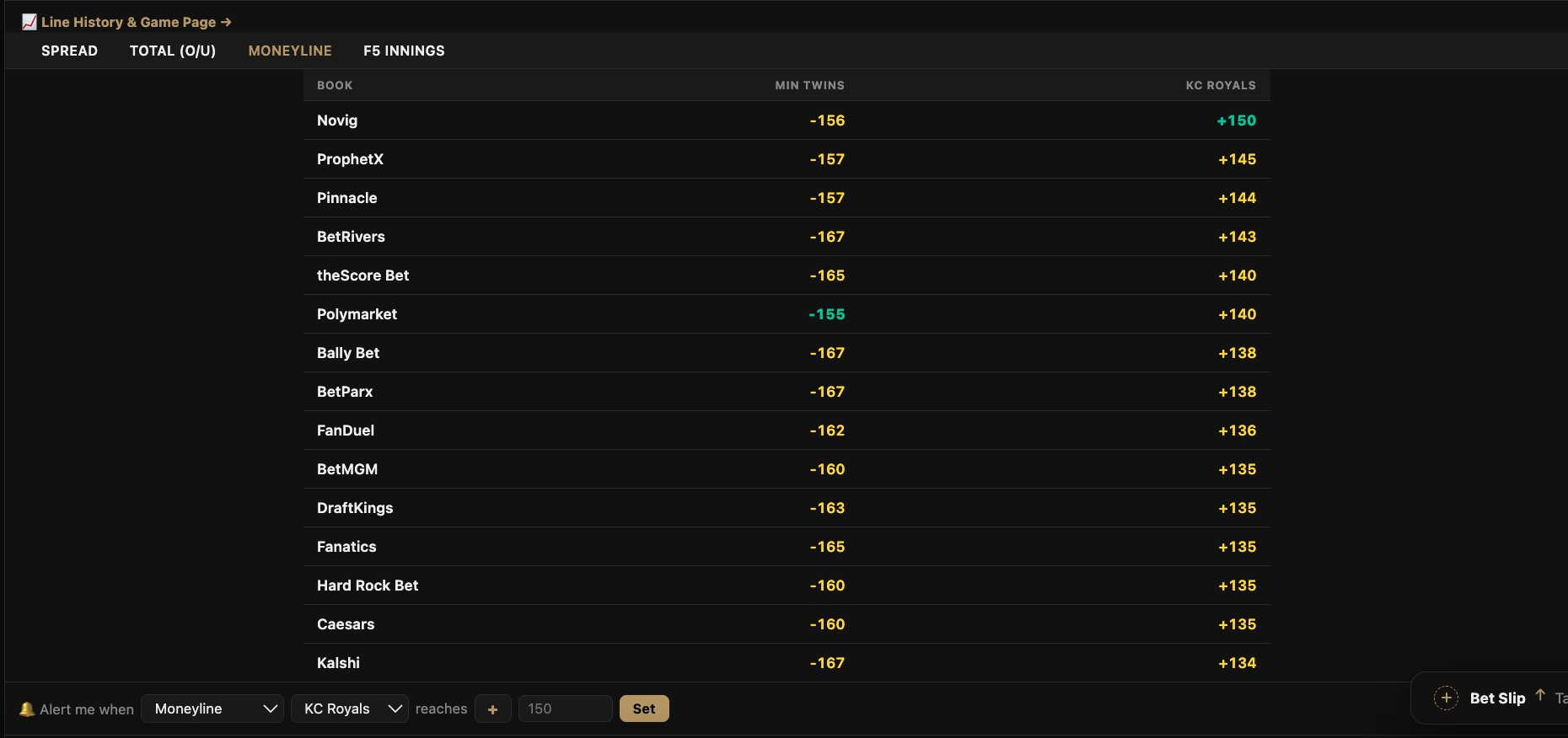
Two exchanges topped the Royals ladder, Novig at +147 and ProphetX at +145, with Pinnacle right behind at +144. This happens often enough that the board carries the prediction markets at all. It is also not a rule: on the Twins side a traditional sportsbook paid best, and Kalshi sat mid-ladder on one side. The best price moves around, which is the entire argument for looking rather than assuming.
This was not one weird game
Anyone can find a single ugly line and write an article about it. So here is the whole board, same morning.
Across the July 28 slate there were 56 game sides priced by at least eight books. The median best-to-worst spread was 3.2 points of implied probability. Forty-nine of those 56 sides, about 88 percent, were 2 points or wider. Exactly zero came in under 1 point. Four were wider than 5.
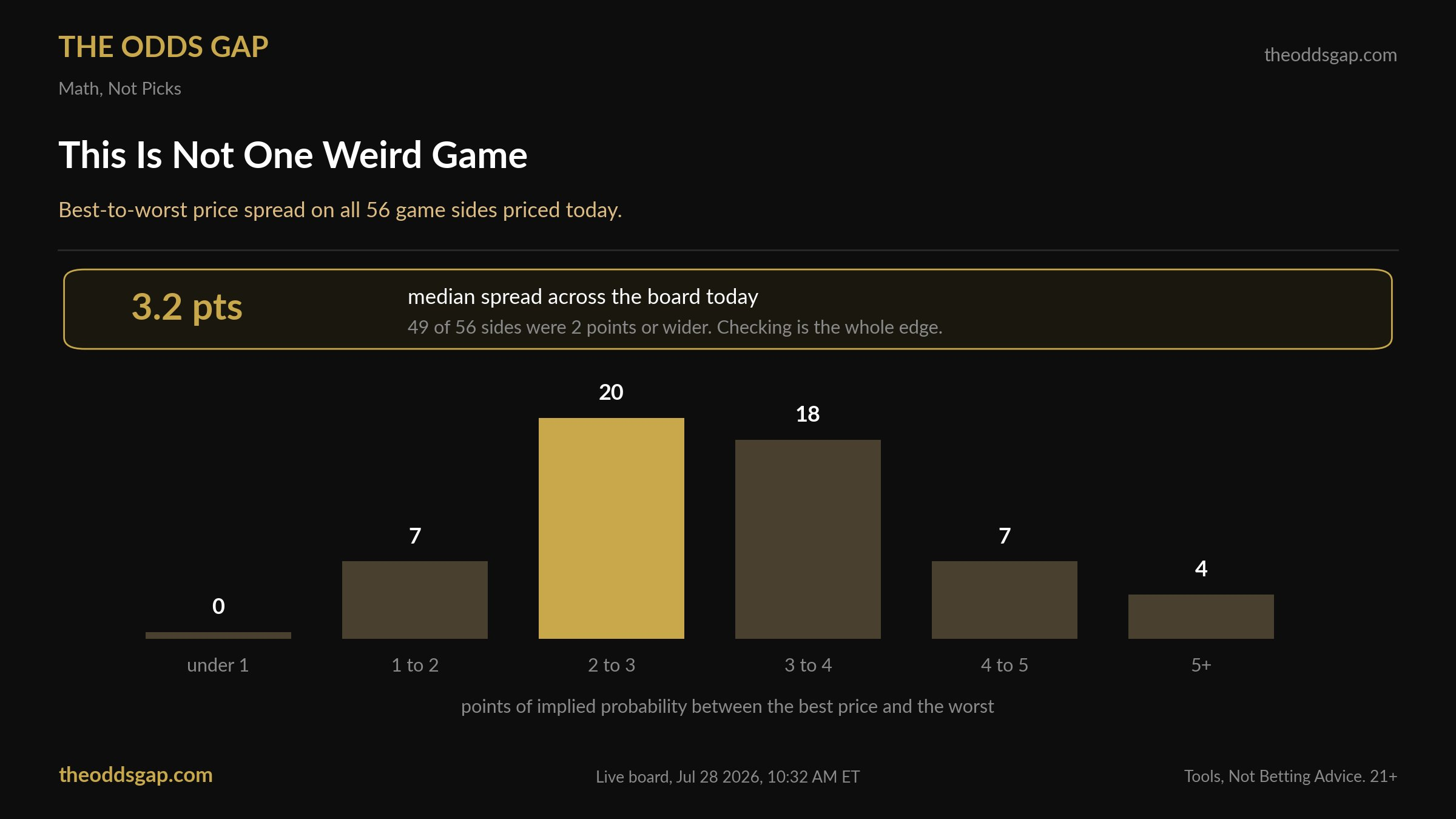
The Royals game was above average, but not an outlier. A typical side on a typical Tuesday carries a few points of spread, and that is what makes shopping a habit rather than a treasure hunt.
How to use it
Open theoddsgap.com. The Line Shop is the front page, no account needed.
Pick your sport from the league chips at the top, or leave it on All to see the full slate. Each game is a card showing home, away, and (for soccer) draw, with the best current price and the book paying it flagged right on the card.
Tap a card to expand it. That opens the full ladder you saw above, every book's price on the same market, sorted with the best at the top. Spreads and totals sit alongside the moneyline, and the board keeps lines matched, meaning a -1.5 spread at one book is compared against -1.5 at the others, not against a different number.
Set your state once and the board filters to books that actually operate where you live, so you are never chasing a price you cannot bet.
When you find your price, the card links you toward the book, and at several books the link opens with the exact bet loaded, so the price you saw is the price sitting in your slip.
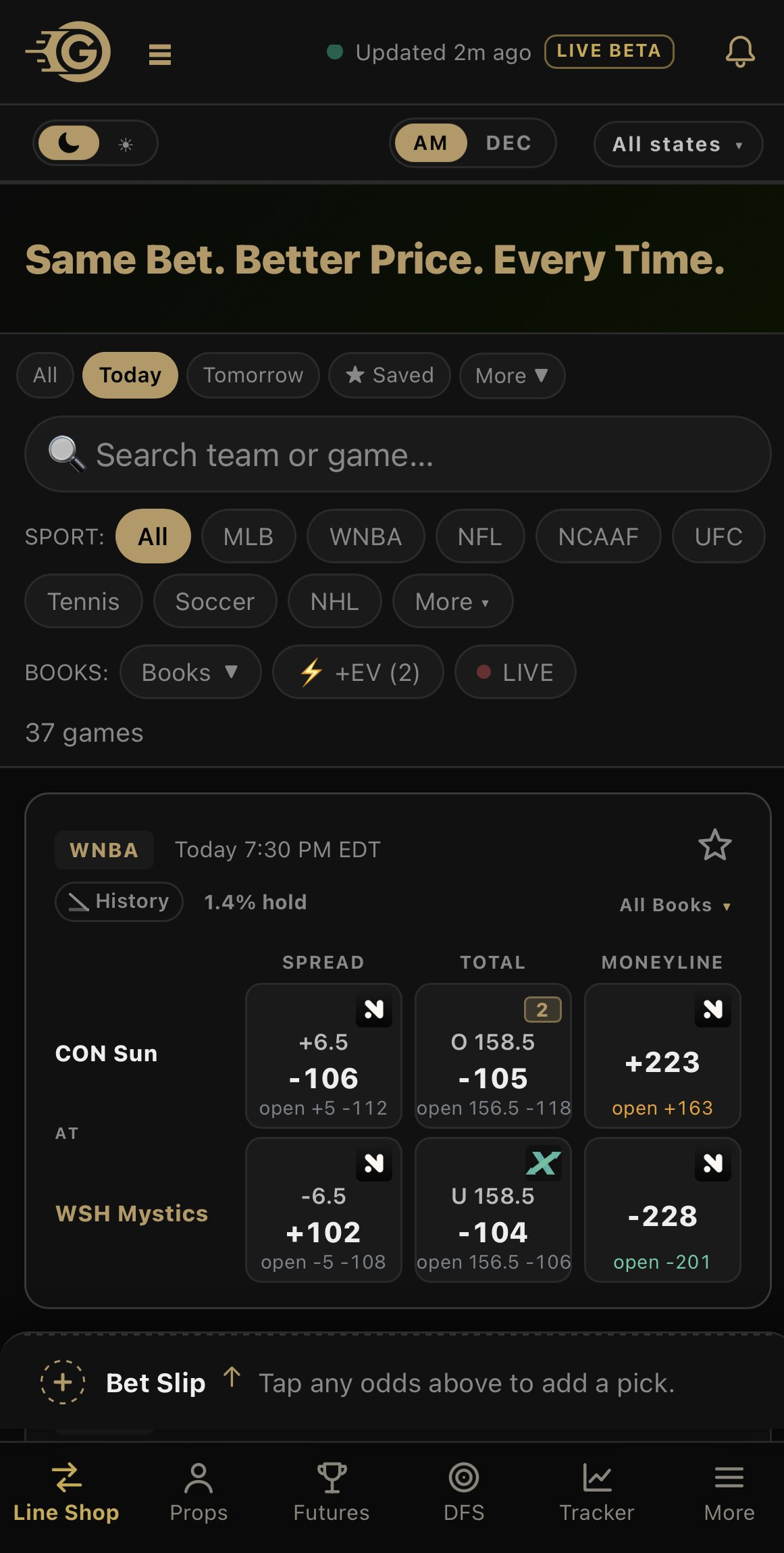
The whole loop takes about twenty seconds longer than betting blind. That is the entire cost of never taking the worst number again.
The math behind the board
Everything above rests on a few rules, all documented in full at theoddsgap.com/methodology.
Implied probability is the translation layer. A price of +125 implies 44.4% (100 divided by 225). A price of -152 implies 60.3% (152 divided by 252). Converting every book's price to a probability is what makes a favorite's price and an underdog's price comparable on one scale, and it is how the board computes the gap between the best price and the field.
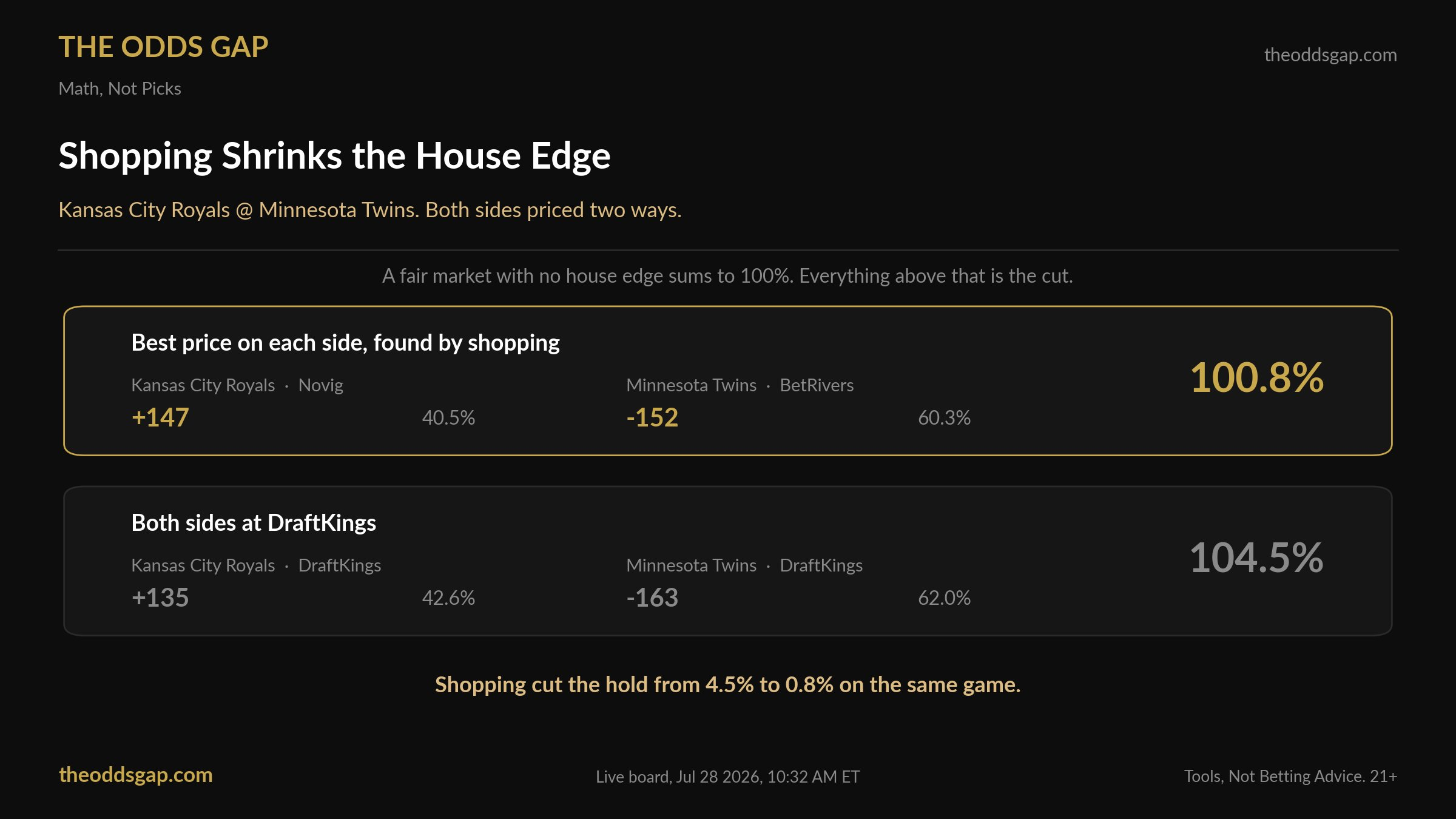
That conversion also shows what shopping does to the house edge. Take the best price on each side: +147 and -152. Those implied probabilities sum to 100.8%, a hold of eight tenths of a percent. Bet both sides at one book instead, DraftKings at +135 and -163, and the sum is 104.5%. Shopping did not just improve one bet. It cut the vig on the whole game by more than a factor of five.
Exchange prices are quoted as what you can actually get, not the teaser number at the top of the order book. The board walks down each exchange's book and quotes the executable fill for a real $100 order, so a price backed by $3 of liquidity never gets flagged as the best available. Kalshi prices are additionally adjusted for its trading fee before they ever touch the board, so a Kalshi price that looks better than a sportsbook really is better after you pay the fee.
Line matching keeps spread and total comparisons honest. Prices are only compared at the same number. A better price on a different line is a different bet, and the board treats it that way.
What the Line Shop does not do
It does not predict games. Nothing on the board is a pick, a projection, or a model saying who wins. The board tells you where an identical bet pays more, and that is all it tells you.
It does not guarantee the price survives until you tap it. Lines move, and a price captured at 10:30 AM can be gone at 10:34. The board refreshes constantly, but the book's own app is always the final word on what you get.
It does not place bets. You still open the book, still confirm the slip, still check the number one last time.
It does not know your promos, boosts, or odds already improved by a book's loyalty program. A boosted price at your book can beat the board's best price, and only you can see that.
It does not rank books for you. Today's ladder had one book near the bottom on one side and at the top on the other. A leaderboard would have hidden that. The per-bet ladder is the honest unit.
And it does not turn losing picks into winners. Line shopping raises the payout on the bets you were already making. If the picks are bad, better prices lose money more slowly, not profitably. What it does is remove the one leak that has nothing to do with skill.
See the best price on your next bet
Live odds from every major sportsbook and four exchanges on one board, the best number flagged on every line. Free, no account needed.
Open the Line Shop →Numbers captured from the live board on July 28, 2026 at 10:30 AM ET. Lines move, so treat every price here as a snapshot, not a quote. Exchange prices (Kalshi, Polymarket, ProphetX, Novig) are shown after fees and as the executable fill for a real $100 order. See the methodology for the full detail, and always verify odds before placing any bet.